Public Channels
- # ai4pacificislandseabirds
- # animal_re-id
- # audio
- # biodcase-active-learning-community
- # camera-traps-hardware
- # camera_traps
- # camtrapai-workshops
- # cv4animals
- # cv4plants
- # cvml-solutions-for-challenging-real-world-conservation-problems
- # datasets
- # elephant_id_database_general
- # esa_2023_happy_hour
- # general
- # geometric_embedding_analysis
- # help_needed
- # jobs
- # marine
- # movement
- # new_papers
- # news
- # ourpapers
- # petitions
- # proj-id-and-count-salmon
- # public-engagement
- # random
- # region-pnw
- # region-us-ne
- # region-us-sw
- # resources
- # tdwg_ml
- # upcoming_events
- # vibe-coding-party
- # visualization
- # what-is-that
- # wildlifeinsights

set the channel description: Keep track of upcoming workshops, symposiums, etc.
ICCV Computer Vision for Wildlife Conservation Workshop: https://cvwc2019.github.io/


@Jennifer Marsman has joined the channel

@Elijah Cole (Deactivated) has joined the channel

@Jeffrey Thompson has joined the channel

@Lily Xu - OLD ACCOUNT, DO NOT MESSAGE has joined the channel
Join us for the #CompSust Doctoral Consortium! Discuss computational approaches to sustainability: climate action, wildlife conservation, public health, and more! Travel funding is available.
Oct 18-20 @ Carnegie Mellon
Apply by: Sept 4
Info: http://www.compsust.net/compsust-2019

@Ștefan Istrate has joined the channel


Hi all, I just got this from Ned Horning at the American Museum of Natural History:
The American Museum of Natural History’s Center for Biodiversity and Conservation (CBC) and the Smithsonian Conservation Biology Institute (SCBI) are working together to organize a mini-conference around the topic of counting plants, animals and other objects on aerial, satellite and other high resolution imagery.
We envision a small (~20 people) two-day meeting with an optional third day with a code sprint for developers and a workshop with training and demonstrations for practitioners. The intent of the meeting is to begin to cultivate a network of conservation practitioners and machine learning experts to assess the current status of machine learning for counting objects in imagery. The objectives will be to: 1) identify common approaches and software tools for manually counting objects of interest in images, 2) identify limitations to current approaches, 3) generate recommendations for innovative cooperative human-machine learning approaches for counting objects of interest in areal imagery, and 4) identify potential collaborative projects and funding opportunities.
At this point, we are primarily looking for an expression of interest. This meeting will focus on terrestrial applications. We hope to follow-up with another meeting focused on microscopic and aquatic/marine applications in the near future. Note, we have yet to secure funding and are looking for potential donors. It would be helpful to know if you would require funds to participate in this meeting and also if you have ideas of funding organizations or individuals that we could contact to provide financial support. If possible, we would like to hold the workshop before the end of this year.
We are also working to decide on a venue. Possibilities include hosting the meeting in New York, NY at the CBC, in Front Royal, VA at SCBI, or in Cornwall, NY at Black Rock Forest. If you have a preference for one of the above venues or have other suggestions, please let me know. Also, if you know of someone else who might be interested in this proposed workshop feel free to forward this message.
Please respond to this request for expression of interest by 15 September 2019 using this online form:. https://forms.office.com/Pages/ResponsePage.aspx?id=6AMAvrnGaEmDrrNFhpdLdh7nbHDObxpDqDmfa5mWxZtUNVVTQzEzV0c4NVdQUkFLMjJHTDdHV0Q1Uy4u
If you have any questions please let me know.
@Siyu Yang might be a connection with the seal project?

this sounds right up our alley for sure, thau... thanks! do you have any links for the form / follow-up? [edit] oops i see the form link! didnt see that at first.. #technology


@Kevin Winner has joined the channel

@Garrett Bernstein has joined the channel

@Riccardo Pressiani has joined the channel

@Thomas Starnes has joined the channel
NeurIPS Workshop on "Tackling Climate Change with Machine Learning" : https://www.climatechange.ai/NeurIPS2019_workshop.html
Date: Friday, December 13 or Saturday, December 14, 2019
Location: Vancouver, British Columbia, Canada
Submission deadline: September 11, 11:59 PM Pacific Time

The CFP for the AI for social good workshop at NeurIPS 2019 is out! AI for Conservation work is definitely relevant to the workshop!
Workshop website: https://aiforsocialgood.github.io/neurips2019/cfp.htm
Submission site: https://cmt3.research.microsoft.com/NIPSJWAISG2019
Contact: aisg2019.neurips.contact@gmail.com
Submission deadline: September 6, 11:59 PM Pacific Time
We are also looking for reviewers. Please email us (aisg2019.neurips.contact@gmail.com) to sign up.
Submissions for the Computational Sustainability Doctoral Consortium close on September 4! We welcome a wide range of work applying computation to topics in sustainability and conservation. Travel funding available.
More info and to apply: Info: http://www.compsust.net/compsust-2019
The ICCV 2019 Workshop on Computer Vision for Wildlife Conservation just released their program! https://cvwc2019.github.io/program.html

If you live in the New York city area, then do stop by Bloomberg Data For Good Exchange 2019 on Sunday, September 15th. We have a planet track this year. If you are interested please drop me a note at: smenon59@bloomberg.net. You can find details about the program at: www.d4gx.com 🌍
If you haven't heard about it already, there is a Camera Trap Technology Symposium happening November 7th and 8th at Google Mountainview, with an option to attend remotely! Read more about it and register here: https://ecodatamanagement.com/symposium/

thought: a google calendar for ai/conservation events (conferences, rfp, etc). it could be public (view, not edit) but we all could aggregate events we post here to the calendar, and even integrate the calendar itself back into slack here. (full disclosure, i have never used the google calendar slack integration, but will optimistically assume it will do what we would want, 😄)
https://slack.com/help/articles/206329808-google-calendar-for-slack

This is a great idea! Do you want to take the lead on setting it up?
i suspect then "we" (on this slack) could become the volunteer editors/maintainers of the calendar content... until some ugly power struggle arises and we need to establish some formal process, and then everyone will be mad i suggested it. 🙂 #theinternet
yeah i can take that on. flex my amateur google calendar admin skills. ha. (and will happily share edit rights as applicable....)
re: the above thread, i have created a google calendar with events form this channel (or at least i put a few in!).. i have not gone into more detail than than and put in things like deadlines for submissions and so on -- but those certainly could be added.
https://calendar.google.com/calendar/embed?src=5q3e71t37c649pko8hlc2tgr6o%40group.calendar.google.com
this is the public url to the calendar. already, i was had the dilemma of not being sure what i should add! (e.g. the camera trap symposium - is this "public"?) -- but since it had a public url, i figure google probably has crawled it anyway. 🙂 thoughts on policy welcome. and most importantly please let me know if you would like to have editing privileges and i will set you up! (please)
I'd be happy to have editing privileges
WILDLABS is hosting a virtual meetup on Camera Traps, Tuesday October 29th. I'll be speaking, along with Roland Kays and Sam Seccombe. Learn more and register here: https://www.wildlabs.net/resources/community-announcements/wildlabs-virtual-meetup-invitation-camera-trapping

Hello Animal Re-ID Enthusiasts!
We (@Stefan Schneider and @Sara Beery) have exciting news! The WACV2020 Animal Re-Identification workshop has been approved and organization is well underway! The workshop webpage is up here: https://sites.google.com/corp/view/wacv2020animalreid/
We think this would be a great opportunity to bring the ecological and ML communities together to celebrate and discuss all the exciting challenges in re-ID, across the image, audio, and video domains. If you have any works you feel are suitable the Paper submission deadline is December 15th, 2019
We call for papers of three categories: Contributed Papers, Extended Abstracts, and Proposals. All submissions should be in PDF format.
Contributed Papers will be published as part of the "WACV Workshop Proceedings" and should, therefore, follow the same guideline as the main conference. Paper submission guidelines of WACV can be accessed here: https://wacv20.wacv.net/index.php/calls/
Extended Abstracts can be up to 4 pages in length, references not included. This option is meant to provide a non-archival submission option for previously published work, or work that is intended to be published at a future venue. Supplementary appendices are allowed but will be read at the discretion of the reviewers.
Proposals can be up to 2 pages in length, references not included. This option is intended to provide a venue for experts to suggest new re-identification projects to the computer vision community for discussion or to develop collaborations. Providing new data is desired but not required.
Please spread the word! We think this is a great opportunity to further the interdisciplinary discussion and collaborations between the CV and ecological communities

The conference will be held on March 2-5, 2020 at The Westin Snowmass Resort in Snowmass village, Colorado. Hope to see you all there!
very exciting - congrats! there should definitely be some of our team from wild me at wacv... should be a great workshop. thanks for all the work on this.

Hi everyone! I’d like to let you know about an event called Try AI I’m helping to organize at the AAAI 2020 conference (https://aaai.org/Conferences/AAAI-20/) in New York City on February 8, 2020. Try AI is a half-day outreach event consisting of a discussion with artificial intelligence (AI) researchers regarding the potential applications of AI in society — like conservation, a chance to present ideas developed during the discussion, and a college and career panel. Our goal is to encourage local high school students, especially all those identifying as women and others traditionally underrepresented in computer science, to consider AI and STEM in general as potential career paths, and make good connections to help them throughout their careers.
To help facilitate this, we are looking for mentors attending the AAAI conference of all career levels - undergraduate, graduate, postdoc, faculty, and those in industry or government - with some experience in AI research. If you’re interested, please apply (https://forms.gle/CBfXqDwnyGji2M1n9) by January 10 and check out our website for more details: https://sites.google.com/g.harvard.edu/tryai. Let me know if you have any questions!


Greetings everyone!
This is a call for papers for the upcoming 7th Workshop on Fine-Grained Visual Categorization. The submission deadline is April 3rd - this Friday.
We invite submission of three page (excluding references) extended abstracts describing work related to fine-grained classification. Accepted submissions will be presented as posters at the workshop (or online on our website depending on the decision reached by the CVPR conference organizers). Reviewing of abstract submissions will be double-blind. The purpose of this workshop is not as a venue for publication, so much as a place to gather together those in the community working on or interested in FGVC. Submissions of work which has been previously published, including papers accepted to the main CVPR 2020 conference are allowed.
You can find more information here and the CMT submission link will be available soon. Feel free to reply to this thread or message me if there are any questions.

Conservation X Labs is hosting a virtual ideathon for ideating behavior change and technology solutions to environmental problems on Sat April 25 (in honor of the 50th Earth Day celebration happening on April 22). We’d welcome your participation and please share! Register here: https://conservationxlabs.com/ideathon
Hi everyone! I'm helping to organize an event for those trying to decide whether to do grad school, especially those traditionally underrepresented in STEM. I'd particularly love to encourage those working on AI and/or conservation 🌳, so please consider attending if you are considering grad school, or sharing the following if you know anyone (e.g., students in your lab, interns, etc.) considering grad school! Thank you!
The Harvard School of Engineering and Applied Sciences Office of Diversity, Inclusion and Belonging presents, Is graduate school right for me?, a virtual panel discussion with SEAS faculty and current graduate students on what factors to consider when deciding on graduate school. The panel will be moderated by Vinothan N. Manoharan, Wagner Family Professor of Chemical Engineering and Professor of Physics, and panelists will include SEAS PhD students: Greg Cunningham (Applied Physics), Elizabeth Gallardo (Materials Science and Mechanical Engineering), Blakely O’Connor (Bioengineering), and Lily Xu (Computer Science). It will take place on May 19 from 3-5pm ET, and will be recorded for later viewing.
We highly encourage underrepresented populations in STEM to attend. Please find additional details and register here: https://tinyurl.com/SEASGradPanel
If you have any questions regarding this event, including accessibility requests, please contact: Alexis Stokes, astokes@seas.harvard.edu & Veronica Santana, vsantana@seas.harvard.edu.
I love this!! After the event can you let us know what worked/didn't for the digital panel? We have a panel about deciding on/applying to grad school every year in the Caltech CMS department, and I'd love any tips you have about migrating our panel to a digital format.
Totally!! It would be great to get these going in many schools every year so people can hear lots of different perspectives 🙂
This is the link to the recording of the above event, in case you or someone you know wasn't able to attend live: https://www.youtube.com/watch?v=sNzdD6O7Rlw&utm_source=SEAS+Community&utm_campaign=37c1432092-InsideSEAS_2020_06_05&utm_medium=email&utm_term=0_4c60eab88d-37c1432092-430361389


Check out WILDLABS' Tech Tutor webinar series!! Thursdays at 11am EST throughout the summer. Great line-up of conservation tech how-to's and easily digestible helpful tidbits!
https://www.wildlabs.net/resources/community-announcements/wildlabs-tech-tutors-season-one
I wanted to point this out to @Ben Weinstein, who I know has collaborators in Latin America, but may be of interest to others as well!
The upcoming MD4SG workshop (Aug 17–19) is devoting an entire half of the second day to LAC researchers with presentations and a panel in Spanish. The work focuses more on education, rather than conservation, but still may be of interest.
http://md4sg.com/workshop/MD4SG20/program.html
Registration is $10, but fee waivers are available, along with data plan top-offs.

thanks. sending along.
More info - https://conservationxlabs.com/con-x-tributors


Predictive Analytics World, a leading conference on machine learning in the private sector, has launched the first PAW Climate, a conference dedicated to machine learning and climate tech. The conference, which is completely virtual, will take place between May 24 and 28, 2021.
Call for proposals:
Startups and established companies that are applying data science and machine learning in areas relevant to climate change mitigation and adaptation (e.g. energy, transportation, agriculture, disaster response) are encouraged to apply to talk about their work. Proposals are due December 15 at:
https://www.predictiveanalyticsworld.com/climate-tech-conference/
The organizers of PAW Climate hold the values of diversity and inclusion in high regard. Those who self-identify as women, underrepresented minorities, or LGBTQ are especially encouraged to apply.
About the conference:
There is a wealth of expertise, passion, and money pouring into climate tech as both startups and established industrial players seek to address one of the most important challenges facing humanity. Machine learning can be an important component in tech for addressing the climate crisis. Join PAW Climate to explore how companies apply machine learning to problems such as smart electrical grids, supply chain optimization, building energy efficiency, industrial control, precision agriculture, climate risk assessment, weather forecasting, ecosystem monitoring, and disaster response.

NeurIPS is happening this week with the EXPO happening today
Shameless plug for Wild Me’s talk this morning, which you can watch here: https://slideslive.com/38942314/automating-wildlife-conservation-for-cetaceans

An ongoing biweekly seminar series at Dartmouth on Tuesday on energy! The upcoming one is tomorrow (Jan 12, 12:15pm ET) on climate and energy equity.
Critical Infrastructure in a Climate Changing World – Dartmouth Energy Collaborative Seminar Series: Tuesday, January 12, Virtual
Climate change is impacting our planet in ways that are becoming ever more apparent. The infrastructure that undergirds modern life — from roads and ports to energy generation installations and transmission lines — is one area increasingly at risk from climate-fueled flooding, fires, extreme heat, and sea level rise. In the first session of our series, "Vulnerable Systems: Climate Urgency and Energy Equity," Professors Erich Osterberg of Dartmouth College and Shalanda Baker of Northeastern University look at the societal impacts of climate change and explore the opportunities for a more equitable energy future. Learn more and register at dartgo.org/EnergySeminars.
Hi all! Talk of potential interest this Monday:
Join us for the next speaker in the Spring 2021 AI for Social Impact Seminar Series
HOW MANY PENGUINS ARE THERE?
(AND OTHER MYSTERIES SOLVED BY SATELLITES AND AI)
Heather Lynch, PhD
IACS Endowed Chair for Ecology & Evolution
Stony Brook University
Monday, February 8, 2021
11 AM EST (UTC-5)
Sign up here: https://crcs.seas.harvard.edu/ai-social-impact
Satellite imagery and computer vision are two transformational technologies that have rapidly, and quite radically, expanded our capacity to study wildlife in the world’s most remote places. In this talk, I will describe my lab’s efforts to combine satellite imagery, drones, and other remote sensing technologies with good old fashioned field work to study the distribution and abundance of penguins and other wildlife in Antarctica. I’ll also discuss the threats facing Antarctic penguins and how scientists are bringing together new technology, artificial intelligence, and advanced predictive modelling to help guide policymakers in their work to protect one of the world’s last remaining wildernesses.
Dr. Heather Lynch is the Institute for Advanced Computational Sciences Endowed Chair for Ecology & Evolution at Stony Brook University and currently a AAAS Leshner Fellow for Science Engagement focused on AI and its applications. Following a B.A. in Physics from Princeton University and an M.A. in Physics from Harvard University, she received her Ph.D. in Organismal and Evolutionary Biology from Harvard University in 2006. Dr. Lynch’s research sits at the intersection of statistical ecology, geography, applied math, and computer science. Her research is focused on all aspects of conservation ecology in the Antarctic, with a particular focus on the integration of satellite imagery and traditional field work to map the distribution and abundance of Antarctic wildlife and to predict how populations will be impacted by climate change, fishing, and tourism.
Cross posting the machine learning working group talk this morning.
Quick reminder we'll be meeting today at 11am PST / 2pm EST / 8pm CET. Hannah Friedrich (Oregon State University) will present on Automating the Detection of Refugee Settlement Establishment and Growth through Landsat Time Series Analysis in Uganda - see their paper on this topic here (also attached).
Bring your questions! As always, full details and updated schedule here.
Zoom link: https://umd.zoom.us/my/hkerner
See you Friday,
Hannah and Patrick


Yes! Hannah F. is one of my colleagues at CBI, I'm looking forward to hearing more about her academic work
Engaging the Academic Community in Combating Wildlife & Forest Crime
March 22, 10am–11:30am EDT
https://www.eventbrite.com/e/engaging-the-academic-community-in-combating-wildlife-forest-crime-tickets-141597264229?keep_tld=1

Agenda:
Agenda
Welcoming Remarks by Dr. Meredith Gore, University of Maryland
The E4J Initiative by Mr. Marco Teixeira, Chief, Doha Declaration Programme
The Role of Academics and Scientists in Conservation Crime by Dr. Antony Lynam, President Elect, Society for Conservation Biology
The 2020 World Wildlife Crime Report by Dr. Angela Me and the Research and Trend Analysis Branch Team, UNODC
Moderated Panel Reflections with esteemed panelists Dr. Helen Agu, University of Nigeria Nsukka, Dr. Inés Arroyo Quiroz, Autonomous University of Mexico and Dr. Anwesha Dutta, CHR Michelsen Institute of Norway
Seems to be a great selection of speakers to discuss academic research for preventing wildlife crime, with AI and beyond!
This looks so cool! Thanks for sharing 🙂
We're thrilled to announce the upcoming Harvard CRCS Rising Stars Speaker Series! This four-part speaker series will feature 16 Rising Stars in AI for Social Impact.
The talks will all take place 12–1:30pm ET
Tuesday, March 30 (Public health) - register
Thursday, April 8 (Conservation) - register (likely of most interest to you all here!)
Tuesday, April 20 (Fairness) - register
Thursday, April 29 (Tech + Society) - register


https://compass.acm.org/call-for-papers/
Separate track on: Environment, Climate Change and Sustainability

A conference in French on AI and biodiversity that might be of interest to some folks 😄https://www.labex-cemeb.org/fr/actualites/journee-scientifique-ia-et-biodiversite-30-mars-2021
Join us Thursday at 12pm ET for the CRCS Rising Stars series on AI for Conservation! Featuring talks by @Elizabeth Bondi, Shiva Iyer, Sasha Luccioni, and Esther Rolf.
Register: https://harvard.zoom.us/meeting/register/tJwlcuGhqDMoGtUQNV_zqRFQhmVg0fHMY8H_
Hi all, we hope you are doing well! We are excited to announce that the 2nd KDD Workshop on Data-driven Humanitarian Mapping will be held virtually at the annual KDD 2021 conference. The workshop brings together a global community of researchers and practitioners to advance the commonly shared data science research agenda on inclusive humanitarian actions and sustainable development. We envision scientific and community-based solutions to address pressing societal challenges that disproportionately impact vulnerable populations worldwide.
For more information, please visit the workshop website and spread the word! We are looking forward to your participation! If you would like to get involved in organizational efforts, please reach out!
Key dates
Submission deadline: May 25, 2021 at 11:59 PM Pacific Standard Time
Acceptance notification: June 30, 2021
KDD Virtual Conference: August 14-18, 2021
Please submit your paper using the submission site
Call for papers and participation
The 2nd KDD Workshop on Data-driven Humanitarian Mapping: Harnessing Human-Machine Intelligence for High-Stake Public Policy and Resiliency Planning solicits research papers, case studies, vision papers, software demos, and extended abstracts. We invite participation from a broad community of researchers and practitioners from academia, industry, government, and nonprofits working on humanitarian mapping in the broader context of crisis response, environmental sustainability, human displacements, the COVID-19 pandemic, food security, climate change, and global development. Fields of interest include but are not limited to, human-centered data science, machine learning, remote sensing, and geospatial data science, AI FATE, urban planning and sustainable development, epidemiology, public health, network science, computational social science, crowdsourcing, ethics, and law. Examples of submission topics include, but again are not limited to:
- Data mining, geospatial analytics, remote sensing, machine learning, data visualization methodologies for humanitarian mapping, with focus on high-stake policy decisions and resiliency planning
- Data-driven methods to understand the dynamics of human movement, evacuation, and short-and-long-term displacements due to natural disasters, climate-change threats, or human conflict
- Privacy-preserving technologies for humanitarian mapping
- Computational methodologies to detect and mitigate biases and fairness in humanitarian mapping datasets
- Computational modeling of social and economic impact of crises (e.g., COVID-19 pandemic, human-climate induced displacements, natural disasters, food insecurity, etc.) on underrepresented and/or marginalized groups including, but not limited to: gender, identity, race, ethnicity, disabilities, socioeconomic status
- Ethics and governance in humanitarian mapping data and technologies
- Data-driven methods to understand resource accessibility (e.g., food, land, water, COVID-19 vaccines, health-care, education)
- Legal and justice issues focused on data governance and policy in humanitarian mapping
- Ethics of humanitarian mapping data governance, sharing, management, validation, and integration
- Insights from real-world cases studies, technology deployments, and humanitarian policy-making
- Critics and limitations of the current state of the arts in humanitarian response systems and processes
- Vision for the future, including rigorous discussions on the gap between theory and policy practice
- Analytics software demonstrations
Submission categories
The KDD Workshop on Humanitarian Mapping solicits five kinds of submissions (Research papers, case studies, vision and critics papers, extended abstracts for published work, analytics software demos)
We look forward to your participation!
Neil Gaikwad, Shankar Iyer, Dalton Lunga, Elizabeth Bondi
Program Chairs, KDD 2021 Workshop on Data-driven Humanitarian Mapping

Hi, All, please consider submitting your work to the KDD Workshop “Fragile Earth: Accelerating Progress towards Equitable Sustainability” . DEADLINE JUNE 6.
We are accepting full papers (up to 8 pages), position papers (up to 4 pages), and policy notes (up to 2 pages).
List of topics:
- Innovations in data science and predictive modeling applied to earth sciences.
- Investigations centering equity in regards to sustainability.
- Data-informed climate change and resource management policy discussions.
- Frameworks for helping the scientific and KDD communities to work together.
FULL DETAILS: https://ai4good.org/fragile-earth-2021/
The workshop "Tackling Climate Change with Machine Learning " at the International Conference on Machine Learning (ICML) 2021 will be held virtually on Friday, July 23rd, from 8:0019:00 ET / 12:0023:00 UTC.
Highlights include:
- Keynote talks from: Kate Marvel (NASA), Shakir Mohamed (DeepMind), Solomon Assefa (IBM Research Africa), and Draguna Vrabie (PNNL)
- 89 research posters from a wide array of fields at the intersection of climate change and ML, 13 of which are highlighted for spotlight talks.
- Two expert panel discussions:
(i) Designing projects and finding collaborators in climate change and ML
(ii) Monitoring and mitigation of emissions in line with Paris Agreement targets
- Interactive poster sessions (via Gather.town) for discussions and networking with authors, speakers, organizers, and other participants.
While the entire workshop will be live-streamed for free, we hope you will register to get the full benefits of the workshop (including the ability to attend poster sessions and ask questions during the live Q&A). General registration is USD 100, dropping to USD 25 for students. (This registration also grants full access to the rest of ICML 2021, which is one of the world’s largest machine learning research conferences.)
Climate Change AI can offer a limited number of registration grants to those who may require financial assistance to cover the cost of the ICML 2021 registration fee. Please apply here if you are interested: https://forms.gle/xxcg5nzvYqkZ7TGK6
For more information, a full event schedule, and info about the free live-stream, please visit the workshop page at: https://www.climatechange.ai/events/icml2021
Feel free to reach out to us at climatechangeai.icml2021@gmail.com for more information or with any questions.
Society for Conservation GIS is having their annual conference virtually July 19-Aug 4 this year. Has technical workshops, prof deve opp’s (including sessions on graduate programs in conservation GIS, getting jobs in the field, etc.) as well as themed sessions of talks (remote sensing, Google Earth Engine, land use, human/wildlife conflict, community land rights and much more).
https://whova.com/web/scgac_202107/
Thanks for posting this! Attendance is free and recordings of sessions are available to all attendees.
I'm helping host a Conservation Networking Happy Hour today from 4-530pm PDT if anyone wants to pop by
https://www.climatechange.ai/events/neurips2021.html
Submissions now open for tutorial proposals, papers, & joining the mentorship program! This workshop is part of the NeurIPS conference (to be held virtually in December)
Registration for EAAMO ‘21 is now live! This inaugural conference on Equity and Access in Algorithms, Mechanisms, and Optimization will focus on bridging research and practice to help improve access to opportunity for historically disadvantaged and underserved communities, which has great relevance to environmental justice.
- Register on Eventbrite by September 10, 2021.
- Financial assistance and data grants are available to facilitate virtual attendance. Please apply here before September 10, 2021.
- Please nominate practitioners working with underserved and disadvantaged communities to join us at the conference (you can also nominate yourself if you are a practitioner). Invited practitioners will be included in facilitated discussions with researchers.


The inaugural Conference on Equity and Access in Algorithms, Mechanisms, and Optimization (EAAMO ‘21) will take place on October 5-9, 2021, virtually, on Zoom and Gather.town. EAAMO ‘21 will be sponsored by ACM SIGAI and SIGecom.
The goal of this event is to highlight work where techniques from algorithms, optimization, and mechanism design, along with insights from the social sciences and humanistic studies, can improve access to opportunity for historically underserved and disadvantaged communities.
The conference aims to foster a multi-disciplinary community, facilitating interactions between academia, industry, and the public and voluntary sectors. The program will feature keynote presentations from researchers and practitioners as well as contributed presentations in the research and policy & practice tracks.
We are excited to host a series of keynote speakers from a variety of fields: Solomon Assefa (IBM Research), Dirk Bergemann (Yale University), Ellora Derenoncourt (University of California, Berkeley), Ashish Goel (Stanford University), Mary Gray (Microsoft Research), Krishna Gummadi (Max Planck Institute for Software Systems), Avinatan Hassidim (Bar Ilan University), Radhika Khosla (University of Oxford), Sylvia Ortega Salazar (National College of Vocational and Professional Training), and Trooper Sanders (Benefits Data Trust).
ACM EAAMO is part of the Mechanism Design for Social Good (MD4SG) initiative, and builds on the MD4SG technical workshop series and tutorials at conferences including ACM EC, ACM COMPASS, ACM FAccT, and WINE.
LifeCLEF 2021 is coming up!
It’s always a great event, and many folks in this channel will be speaking/attending, including @Lukas Picek @Sara Beery @Alexis Joly
https://www.imageclef.org/LifeCLEF2021
“Since 2014, LifeCLEF has been organizing large-scale challenges on biodiversity identification and prediction in the context of the CLEF international conference. The annual workshop is a unique opportunity to bring together specialists from different backgrounds: machine learning, ecology, citizen science, biodiversity conservation. It is also an opportunity to have an overview of the state of the art of artificial intelligence techniques for (i) the identification of plant and snake species by images, (ii) the recognition of bird sounds and (iii) the prediction of species distributions from remote sensing images.”


Are you using AI operationally for ocean science?!
Consider submitting an abstract to our upcoming session “Realizing the Promise of Marine AI: Moving from Research Operations” (OD03) at the Ocean Sciences Meeting 2022 #OSM22 #ai #noaa-- abstracts due September 29th!
https://www.aslo.org/osm2022/abstract-guidelines/
AAAI-22 workshop on Agriculture and Food Systems https://aiafs-aaai2022.github.io/ (submission deadline November 12)
I'm giving the LSU biology colloquium on my lab's recent computer vision + AI + wildlife monitoring work at 1pm ET. I think its okay if I share the link: https://lsu.zoom.us/j/96736378857?pwd=NFhFa3dqSnNtdEtxc2NLV2JyQ0xZQT09
Hi everyone!
We are pleased to announce the upcoming 9th Workshop on Fine-Grained Visual Categorization (FGVC9) which will be held in conjunction with CVPR 2022 this June. More details below, but the key points are:
- Paper submission deadline is 25th March 2022
- Website with more information is here: https://sites.google.com/view/fgvc9
Historically, we have had a great turn out from people in the intersection of conservation and technology. If you are working in that space and have applications in image understanding, please consider submitting your work.
FGVC9 - The Ninth Workshop on Fine-Grained Visual Categorization
19th June 2022 @ CVPR 2022
Website:  https://sites.google.com/view/fgvc9
Twitter: @fgvcworkshop
Email: fgvcworkshop@googlegroups.com

This workshop brings together researchers to explore visual recognition across the continuum between basic level categorization (object recognition) and identification of individuals (face recognition, biometrics). Participants are encouraged to submit short papers and to take part in a set of competitions organized in conjunction with the workshop - details below. We will also have an exciting lineup of invited speakers from computer vision through to domain experts.


PAPER SUBMISSION
We invite submission of 4 page (excluding references) extended abstracts on topics related to fine-grained recognition. Reviewing of abstract submissions will be double-blind. The purpose of this workshop is not specifically as a venue for publication so much as a place to gather together those in the community working on or interested in FGVC. The workshop proceedings will not appear in the official CVPR 2022 workshop proceedings. Submissions of work which has been previously published, including papers accepted to the main CVPR 2022 conference are allowed.


PAPER SUBMISSION DATES
** Deadline for Submission - 25th March 2022
** Notification of Acceptance - 25th April 2022
** Camera Ready - 6th May 2022
** Submission will be via CMT

Scope
The purpose of this workshop is to bring together researchers to explore visual recognition across the continuum between basic level categorization and identification of individuals within a category population. Topics of interest include:

Fine-grained categorization
Novel datasets and data collection strategies for fine-grained categorization
Low/few shot learning
Self-supervised learning
Semi-supervised learning
Transfer-learning
Attribute and part based approaches
Taxonomic prediction
Long-tailed learning

Human-in-the-loop
Fine-grained categorization with humans in the loop
Embedding human experts' knowledge into computational models
Machine teaching
Interpretable fine-grained models

Multi-modal learning
Using audio and video data
Using meta data e.g. geographical priors
Learning shape

Fine-grained applications
Product recognition
Animal biometrics and camera traps
Museum collections
Agricultural
Medical
Fashion


COMPETITIONS
We will also be hosting several fine-grained computer vision challenges with tasks ranging from classification of attributes in art images through to classifying diseases in plants. The competitions will be hosted on Kaggle and will be announced in late February 2022.


ORGANIZERS
Sara Beery - Caltech
Serge Belongie - Cornell
Elijah Cole - Caltech
Xiangteng He - Peking University
Christine Kaeser-Chen - DeepMind
Oisin Mac Aodha - University of Edinburgh
Subhransu Maji - University of Massachusetts, Amherst
Abby Stylianou - Saint Louis University
Jong-Chyi Su - University of Massachusetts, Amherst
Grant Van Horn - Cornell
Kimberly Wilber - Google

If you are going to CVPR and your ❤️ beats for remote sensing and the environment, consider submitting to the EarthVision workshop: https://www.grss-ieee.org/events/earthvision-2022/ . And @Dan Morris and @Tanya Berger-Wolf will be two of our keynotes! Hope to see you there!

reminder for those interested in remote sensing and machine learning today (from @Hannah Kerner).
This is a reminder that we are meeting today at 11am Pacific time/2pm Eastern time. We will hear from Rohit Mukherjee (University of Arizona) for his talk titled "Mapping Clandestine Infrastructure in Central America’s protected areas affected by narco-trafficking using Multi-sensor Data Fusion and Deep Learning".
We're looking forward to seeing everyone. Bring your questions! As always, full details and updated schedule here.
Zoom link: https://umd.zoom.us/my/hkerner
Hi all. Reminder that the paper submission deadline for the Ninth Workshop on Fine-Grained Visual Categorization (FGVC9) is this Friday.
https://sites.google.com/view/fgvc9/submission
Scroll up in this channel to see a more detailed description.


Hi all, I want to advertise an upcoming geospatial + ML workshop -- "Complex Data Challenges in Earth Observation" https://www.iarai.ac.at/workshops/workshop-on-complex-data-challenges-in-earth-observation-2022/ -- with a submission deadline of May 31st. This is a satellite event at IJCAI 2022 and should be great 🙂!
Hi everyone,
This is a reminder that our next ML4RS discussion will be today at 11am Pacific time/2pm Eastern time. We will hear from @Zhongqi Miao (University of Washington) for their talk titled "Challenges in deep learning: Applications to real-world ecological datasets". See abstract below.
We're looking forward to seeing everyone. Bring your questions! As always, full details and updated schedule here.
Zoom link: https://umd.zoom.us/my/hkerner
Title: Challenges in deep learning: Applications to real-world ecological datasets
Abstract:
Deep learning has attracted much attention from the ecological community for its capability of extracting and generalizing patterns from datasets with highly complicated structures, such as images, audios, and motion signals. However, despite the promising cases, deep learning may have shortcomings when applied to real-world ecological datasets.
In this presentation, I will summarize four characteristics of realistic datasets: 1) long-tailed; 2) open-ended; 3) multi-domain; and 4) imbalance between labeled v.s. unlabeled data. Then, I will focus on one of our most recent papers: Iterative human and automated identification of wildlife images, making AI recognition systems deployable with efficient humans in the loop and imperfect models.
- @Hannah Kerner , @Patrick Gray and Ben
Starting now.
Hi everyone,

Our next ML4RS discussion will be this Friday May 13 at 11am Pacific time/2pm Eastern time. We will hear from Nico Lang (ETH Zurich) for his talk titled "Mapping Vegetation Height — Probabilistic Deep Learning for Global Remote Sensing". This talk will cover the following papers:
Country-wide high-resolution vegetation height mapping with Sentinel-2
Global canopy height regression and uncertainty estimation from GEDI LIDAR waveforms with deep ensembles
A high-resolution canopy height model of the Earth
We're looking forward to seeing everyone. Bring your questions! As always, full details and updated schedule here.

Zoom link: https://umd.zoom.us/my/hkerner

- Hannah & Patrick
For those doing AI/related analyses with audio data….from the Kitzes lab at U Pittsburgh -
https://wildlabs.net/discussion/audio-data-across-domains-audioxd-workshop


Hiya, I plug for an upcoming radar + ecology conference starting tomorrow at Davos https://globam.science/irac-2022/ right before the global biodiversity forum. Would love to say hello if you are attending 🙂
https://biodt.eu/events/webinar-biodiversity-digital-twin-protection-restoration-ecosystems

Hi everyone,
My school (UCSB) is hosting a talk today on Zoom (details below).
Anna Boser from the Bren School for Environmental Science and Management will be presenting her talk:
Machine learning and remote sensing elucidate an 80% water savings potential in California agriculture.
Hope to see you all there!
Best wishes,
Eddie
Zoom link: https://ucsb.zoom.us/j/86914716526?pwd=Qnpmd2JEZG5pR2YzN0JxSEovUDg4dz09
Meeting ID: 869 1471 6526
Password: 833796
_______________________________________________
GScubed mailing list
GScubed@lists.engr.ucsb.edu
https://lists.engr.ucsb.edu/mailman/listinfo/gscubed


Hi friends, the Association for the Advancement of AI (AAAI) 2022 Fall Symposium (Nov 17-19, 2022) will run a workshop on The Role of AI in Responding to Climate Challenges. There’s also an open call for submissions for one more week (deadline: Jul 29, 23:59 AOE)!
Hi all, I want to advertise the NeurIPS AI for Humanitarian Assistance and Disaster Response Workshop -- https://www.hadr.ai/. The submission deadline for papers, retrospectives and demonstrations is September 30th. This year's iteration of the workshop will (hopefully) feature an off-site day with the City of New Orleans Office of Homeland Security and Emergency Preparedness team. They will demonstrate how disaster response happens in practice which (I think) will help us (NeurIPS attendees 🙂) see potential gaps between model development / research and what happens in deployment. Please reach out (here or caleb.robinson@microsoft.com) if you have any questions.

Hi all, nice talk today at 11am PT. Tailor-made Neural Architectures for Better and Faster Satellite Image Time Series Encoding. Vivien Sainte Fare Garnot (https://scholar.google.com/citations?user=2r5slBsAAAAJ&hl=en) (Postdoctoral researcher at EcoVision Lab, ETH Zurich). https://umd.zoom.us/my/hkerner

Is there a recording somewhere of this? Would love to check it out!
no, these sessions are not typically recorded.
Multi-day workshop series on Machine Learning Advances for Marine Acoustics and Imagery Data.
https://meridian.cs.dal.ca/2022/09/09/upcoming-ocean-networks-canada-onc-meridian-workshop/

WWF Fuller Science programme has an upcoming series of webinars about AI in conservation. First one is today! https://wildlabs.net/article/upcoming-wwf-webinar-series-artificial-intelligence-and-conservation

Also - our variety hour event tomorrow is featuring David Rolnick from the Climate Change AI community who is going to give an introduction to what they're all about. Might be of interest to folks here! https://wildlabs.net/event/variety-hour-october
Hi everyone! I lead Try AI, a nonprofit committed to broadening participation in the field of AI. We are running a micro-internship for undergraduate students in January, and are seeking both mentors and mentees. Please consider applying and/or sharing! Thank you!

What’s the scope of this? Is it a US only thing?
Yes, for this iteration. It's particularly based in MA. We hope to expand the scale in the next few years!

For anyone heading to Spokane, WA for the annual TWS meeting @Catherine, @Sara Beery, and myself have put together an informal AI for Conservation meet and greet at Black Label Brewing (https://www.blacklabelbrewing.com/) on Wednesday night (7:30_9:30 PM). Please invite friends and come say hi.
https://www.xcdsystem.com/tws/program/3fe8AWm/index.cfm?pgid=198

BTW I not only had fun at this event, I learned a lot about moose. Thanks for organizing!
Happy to be a part of it! It was great to meet everyone.

Hey guys, at FruitPunch AI we have launched the AI for Seals Challenge, to work on facial ID for seals together with Colgate University. Anyone with a basic understanding of Python and about 8 hours per week to spare is welcome to join for this 10-week project. 🦭
- Applications: until 4 Dec 2022
- Launch: 6 Dec 2022
- Final Presentations: 13 Feb 2023
Also, if anyone know of any additional datasets of photos of seals that we could use to train the models, let me know!

One day’s session (that Wednesday I believe) is focused on using AI for Audiomoth recordings. https://twitter.com/NilsBouillard/status/1584203265243127808?s=20&t=ndlY5f5TxsR0sJErSIrqVw
Registration link - https://wwfus.zoom.us/webinar/register/WN_coBMxGbEQY-LiGcQuCwH8g

We are pleased to announce that the 1st workshop on Machine Learning for Remote Sensing will be held in person at ICLR on May 5th 2023 in Kigali, Rwanda. A virtual participation option will be available.
The Machine Learning for Remote Sensing workshop will provide a platform for researchers to share their work on machine learning applied to remote sensing with a particular focus on challenges raised by applications in the African context, including sparse and noisy labels, high intra-class and low inter-class variability and distribution shift from the global North (where many labels exist).
We invite original research paper submissions from a wide range of topics related to machine learning for remote sensing. Please consider submitting a paper describing your work. We will solicit two types of papers: short proposal papers (3 pages) and short papers describing new and ongoing/in progress research (4 pages). Page limits do not include references, which are unlimited.
Important dates:
- Submissions are now open via CMT: https://cmt3.research.microsoft.com/ICLRMLRS2023
- Submissions will close February 3rd, 2023, 11:59 PM AoE. There is no separate deadline for abstracts.
- Withdrawals are possible until March 3rd, 2023.
- Accept/reject notifications will be sent March 3rd, 2023.
- Authors of spotlighted papers will be invited to give a short talk at the workshop and will be notified with details shortly after the acceptance notifications.
- Camera-ready pdfs and posters of accepted submissions are due by April 21st, 2023 11:59 PM AoE.
- Accepted submissions will be posted on the workshop website on April 22nd, 2023, and not before. Rejected or withdrawn submissions will not be posted.
- The workshop will take place in person (with virtual participation option) on May 5th, 2023.
Machine Learning for Remote Sensing is non-archival and thus dual submission is allowed where permitted by third parties. More details can be found here: https://nasaharvest.github.io/ml-for-remote-sensing/iclr2023/#call-for-papers. We will update this page continuously with additional information as it becomes available.
Should you have any inquiry, feel free to contact us at: ml4rs_iclr23@googlegroups.com
On behalf of the organizers of Machine Learning for Remote Sensing, we are looking forward to your submissions and participation!
kigali seems to be the hot spot for conferences this year!
https://conbio.org/mini-sites/iccb-2023/

A colleague is organizing an interesting conference, I leave you the info:
Ecosystem management under changing conditions needs new tools to insight and forecast forest dynamic and management. Artificial intelligence is a game changer in forest management. Artificial intelligence (AI) encompasses a wide range of techniques and frameworks dating back to the mid twenty century. The use of AI in forestry and ecosystems management is relatively new, especially when compared to the early adoption of AI in other fields. The irruption of AI spins researchers and practitioners to unfold the analysis of complex big data. Narrow AI, defined as an AI system that is specified to perform a limited task, is commonly applied in biometry (e.g., analysis of forest structure with 3D point cloud data) but no so common in other ecosystem management domains. Currently, adequate AI algorithms can be efficiently prototyped due to plenty of publicly available databases, open-source libraries and the accessibility to computing platforms.
To insight on this topic and share last works, We, at the University of Valladolid (Campus at Palencia) Spain, are organizing a Conference on Artificial Intelligence and Ecosystems Management You can have update information at https://eventos.uva.es/92504/detail/artificial-intelligence-and-ecosystems-management.html Registration is currently open
This conference is part o the IUFRO unit 4.01.02 - Growth models for tree and stand simulation, but is open to the scientific community interested in the Conference's topic, including agricultural ecosystems.
Looking forward to seen you in Palencia Spain
Best regards
There is an interesting set of talks about “AI for Earth and sustainability”: https://aiforgood.itu.int/eventcat/discovery-ai-for-earth-and-sustainability-science/ Mark your calendars!


Here's a direct link to the registration form: https://docs.google.com/forms/d/e/1FAIpQLSfv8Rgc5WeNiAl-n3ydZ-h8dk7CUgwFpHM1gApML9kbGjgUaw/viewform
Hi everyone - our upcoming Tech Tutors series for the first time ever doesn't have any talks specifically about ML applications in conservation. However, it may still be of interest to folks in this community who are interested in learning more about tech use in conservation, and about the sort of data and questions conservationists are grappling with on the ground. I've no doubt ML is going to have a role to play in some of these work flows in the future, so this could be a series that opens up some opportunities that don't exist yet.
This season, Tech Tutors is heading to East Africa and answering the "how do I do that?" questions of conservation tech. Organised and hosted by Netty Cheruto, our fantastic line up speakers will provide quick, practical, and interactive answers to questions emerging from our growing regional community. From #cameratraps, #GIS/RS, #drones, #aerialsurveys, #PAM tools, #biologgers, wildlife crime tools and much more, our tutors will show you how to put these #tech4wildlife tools into use in the field or lab, and give you an opportunity to ask questions and get advice through live Q&As!
Learn more and register for our first session, starting next thursday here: https://lnkd.in/efQ6yqdW
https://www.cv4animals.com/call

https://twitter.com/hannah_kerner/status/1624214580544282625


 Twitter
@Dan Morris the preliminary schedule for this years butterfly field trips in Washington can be found on page 6 of this newsletter! https://wabutterflyassoc.org/wp-content/uploads/2023/02/GnumVol24No1.pdf
And then eventually at this URL: https://wabutterflyassoc.org/events/
Hi everyone, FruitPunch AI 🍉 is hosting another 10-week AI for Wildlife Challenge, this time focused on European wildlife. We've teamed up with Rewilding Europe, the Swedish University of Agricultural Sciences and WWF Spain to detect and classify species that they've captured on their camera traps.
By joining for 8h/w, AI for European Wildlife is a great opportunity to
- get started with ML in the Wildlife domain
- get your hands dirty with real datasets (~1M images), working for real stakeholders
- learn from enthusiasts and experts from all over the globe, both peer 2 peer and in Masterclasses
- build a network in AI for conservation
This is the first in a series of camera trap Challenges, where our ultimate goal is to build a general model architecture that can quickly be adapted to specific species & locations with relatively limited training sets.
This upcoming NASA training might be of interest!
https://wildlabs.net/event/arset-fundamentals-machine-learning-earth-science


I love the design of this poster!
"From protecting some of the world’s most threatened species to keeping plastic out of the ocean, small, conservation technologies are helping solve some of the planet’s biggest environmental problems.
Join some of the world’s leading experts in conservation technology to show how anyone can create powerful environmental technologies. The two-hour seminar will focus on environmental problems, available technologies, and sources of funding to help innovate.
April 29, 2023
Webinar
Begins: Noon (Pacific)/3 pm (Eastern)
Ends: 2:30 (Pacific)/5:30 pm (Eastern)
https://www.washingtonpolicy.org/events/detail/conservation-technology-101-how-you-can-innovate-for-the-planet

Hi everyone 👋
we are organising a hybrid workshop in Jena, Germany as a part of the international workshop series on camera traps and AI analysis for wildlife monitoring. We would like to invite all interested researchers working on related topics. Please see our webpage or the Wildlabs event for more information. Here is also a call for papers as a PDF, if you would like to distribute it in your research group.
Paper submission deadline: 16. June 2023
Notification of acceptance: 31. July 2023
Camera-ready version submission: 11. August 2023
Workshop: 07. - 08. September 2023
Thank you in advance, and we are looking forward to your participation!
Best Regards from Jena,
Dimitri and Paul
A small update about the workshop: the CMT-website for the submissions is online! (https://cmt3.research.microsoft.com/CamTrapWS2023)
Hey guys, another AI for Good Challenge in the wildlife domain by FruitPunch: AI for Pelicans. (We work on other SDGs too, I swear 😇)
This time we're counting pelican nests on aerial photography.
By joining for 8h/w, you can
- get started with ML in the Wildlife domain
- get your hands dirty with real datasets, working for real stakeholders
- learn from enthusiasts and experts from all over the globe, both peer 2 peer and in Masterclasses
- build a network in AI for conservation
applications are open until the 28 May & the Challenge runs from 30 May until 8 August
As a Romanian it's really exciting to see this challenge being put together! Eastern Europe has a lot of biodiversity in need of protection.

This is amazing!! The pelican population got a huge hit after this years avian flu, I saw myself the numbers getting reduced to peanuts in the coast of Peru this summer.
All the more reason to get conservation into the 21st century 🙂

I'm interested in joining, but I don't have a computer science background, so I'm afraid I won't be of much help... Is it possible to join as a learner vs a contributor?
A formal CS background is not necessary. Do you have some experience with programming in Python?

Leveraging AI to quantify biodiversity and ecosystem change 🐼
University of Liverpool
Wednesday 17 May 2023 - Thursday 18 May 2023
Time: 09:00 - 17:00
https://www.turing.ac.uk/events/leveraging-ai-quantify-biodiversity-and-ecosystem-change
Hi guys 👋
I just wanted to announce the invited speakers for our hybrid workshop in September:
Prof. Dr. Daniel I. Rubenstein
Princeton University
Behavioral Ecology and Conservation
Prof. Dr. David Schedl
University of Applied Sciences Upper Austria
Visual Computing
Zeiss AG
The speaker and the topic
will be announced soon
P.S.: don't forget the paper submission deadline on the 16th of June!
Conservation GIS-centric event
Join our free virtual conservation meetup co-sponsored by the Society for Conservation GIS and the Conservation Biology Institute on Thurs. June 15th @5:00 pm PT / 8:00 pm ET!
Register here: https://us06web.zoom.us/meeting/register/tZAtd-ihrD8jGNLFjsoAOiVso1AEDJD9VKFQ
This meetup will offer an avenue to learn about upcoming virtual SCGIS events, (such as our annual conference), and volunteer opportunities, (esp. for social media support). Participants will also have a chance to informally network with other conservationists using geospatial technology to make a difference.
All are welcome to join so please share this invite with your networks, and special thanks to those who support our SCGIS community as active members!
Can't wait to see you there,
- Shared on behalf of the SCGIS Communications Committee

Hello people, in about a week the CV4animals workshop https://www.cv4animals.com/ will take place at CVPR2023 in Vancouver. Check out the updated list of speakers (including @Devis Tuia!) and orals/posters. Format is hybrid.

no pressure 🙂
Oh I see lots of datasets in the 2023 papers I can add to my many lists of lists of lists of datasets. Will there be posters / links / etc. like there are for the 2022 papers?
Also, if anyone happens to be coming down to the Seattle area when you're in the area (sort of) for CVPR, and you want to check out local wildlife and talk AI for conservation, let me know.
@Dan Morris, drive up to Vancouver!

Hello! We are organizing a workshop on Computer Vision for Environment Monitoring and Preservation, in conjunction with the International Conference on Image Analysis and Processing (ICIAP23), to be help in Udine, Italy, Sept 11-15.
Participants will also be invited to submit to a special issue in the new Open Access journal ISPRS Open Journal of Photogrammetry and Remote Sensing.
Hopefully of interest for some people here!
The deadline for paper submission is July 31st
Hi , FruitPunch AI is at it again: After finishing up AI for European Wildlife with @Dan Morris' help, we've now launched the AI for Eagles Challenge. 🦅
We'll be using ML to distinguish between golden eagles and white-tailed eagles and to classify golden eagles into different age groups. This greatly speeds up ecologists' and conservationists' work on population monitoring.
Anyone that joins us for 8h/w can
- spread their wings in ML for the Wildlife domain
- dig their claws into real data, working for stakeholders in conservation
- learn from a flight of AI enthusiasts and experts from all over the globe - peer to peer and in Masterclasses
- expand their network to soar in AI for conservation
The Challenge runs from August 1 until October 10

This sounds great! How much experience with ML is required?
My main work is as a software engineer with some experience with ML
That's more than enough! We've got a wide variety of experience levels in the Challenge, so there's always someone to learn from, or someone that can learn from you 🙂
Great! Just signed up now - hopefully get accepted 🤞
I am giving a talk to the NASA SERVIR group (https://www.nasa.gov/mission_pages/servir/index.html) on weds if anyone is interest in hearing about where we are with deepforest and NEON tree species predictions.
Hello All,

I am excited to share that Ben Weinstein will be presenting on this Wednesday July 12 at the Working Group.

Title: Individual Tree Prediction from Above

Summary of the Talk:
Airborne data collection can broaden the extent of forest monitoring to unprecedented scales. The growth of machine learning for remote sensing, coupled with the increasing availability of very high resolution sensor data allows for broad scale forest inventories without sacrificing detail on individual trees. Combining optical, hyperspectral and LiDAR data, our research group has been working within the National Ecological Observatory Network (NEON) to produce individual tree maps containing tens of millions of trees. Each tree has a predicted location, height and species label for twenty five geographic areas from diverse ecosystems across the United States. I will discuss a range of deep learning models using weak supervision, domain transfer, and multi-temporal ensembling for individual tree detection and species classification. The future of airborne tree ecology will rely on portable models that share features across time, space and taxa, improved data through national and international collaboration, and an honest appraisal of current algorithm limitation and uncertainty. Our predictions and models are available online, as well as through the DeepForest python package for greater reproducibility and data sharing.

Recurring meeting invite
TensorFlow Working Group Bi-Weekly Meeting
Bi-weekly Wednesday, 10:00 – 11:00 AM CT
Google Meet joining info
Video call link: https://meet.google.com/jmo-ojko-imx

Add invite to your Google Calendar:
1) Go to the Official TFWG Calendar
2) Click "+ Google Calendar"  in the very bottom right corner to add to your Google Calendar.

Thank you and see you,
Biplov


the SERVIR program is awesome! Hope the talk goes well

I can't join the call. Is a registration required to join?
sorry if you missed it, they did record it. https://youtu.be/AOSVdGUXlKw


Is there a way I can add the Wildlabs events into my calendar automatically. I keep missing the variety hours 😢
You get an email when you register for them that has a calendar invite! Make sure you’re signed up to the listserv to get those emails 🙂
ping - @Stephanie O'Donnell
We've been so busy we haven't been giving out a lot of notice SORRY
BUT - talia will add you directly to the zoom invite each month if you really want us to!
Yessss please ❤️
ping me your email and we'll add you
if only there was a standard protocol for sharing calendar events that has been around for 12+ years. lol 😭
Hey we do have one! I was giving kalindi the vip treatment 😂
ooo! 🤩 where? i am checking out the events page now... 🔎
(is it obvious i am a big fan of subscribing to calendars? haha)
Did the calendar subscription link make it to the public website somewhere? I'd love to use it as well.
I should not have offered whoops
As there is some demand let me figure it out in some of our downtime at iccb
meanwhile you can drop August in your calendars here: https://wwfus.zoom.us/meeting/register/tJwlfuGgqjwtH9fLZxauxS1S0I7qc12Zy1XO?_x_zm_r[…]1689786951762.43372d656a095ad31714de20b5ba3147&_x_zm_rhtaid=16
Keeping the theme going, we are hosting a ESA oral session with several members of this group. Come support @Dan Morris @Sara Beery @Tessa Rhinehart @Kakani Katija and others as we discuss how we get to general models for ecological monitoring. I'll be at the happy hour, and I hope to host a dinner in my backyard (I live 10 minutes away) if we can arrange it.
Session Information

Session Title: The Future of Ecological Monitoring Is Collaboration with Artificial Intelligence
Session Type: Organized Oral Session
Date: Monday August 7, 2023
Session Time: 3:30 PM - 5:00 PM Pacific Time
A backyard dinner would be fantastic if you can hold us!
Registration form for in-person participants for the CamTrap Workshop is online now: https://forms.gle/T8LqqUuRiBeSZHPA9! The presentation schedule will be available on the workshop website (https://inf-cv.uni-jena.de/camtrap-ws/) soon. Keep in mind: the workshop is hybrid and will be streamed. So if you are not able to join us in Jena, you will have the possibility to join via Zoom.

Hi everyone,
I am helping organize the NeurIPS 2023 workshop on Computational Sustainability. Computational sustainability (CompSust) is an interdisciplinary research area that uses computational methods to help address the 17 United Nations Sustainable Development Goals (UN SDGs), including but not limited to hunger and poverty reduction, infrastructure development, and environmental conservation. While we encourage all submissions related to computational sustainability, this year’s workshop will have a special focus on promises and pitfalls on the pathway from theory to development. In particular, we encourage submissions with negative results that highlight challenges and gaps in existing methods.
We invite submissions of 4 pages, with an emphasis on topics related to deploying computational sustainability methods. Reviews will be double-blind. The workshop does not publish proceedings, and submissions are non-archival. Submission to this workshop does not preclude future publication. Submissions of work which has been previously published, including papers accepted to the main NeurIPS 2023 conference are allowed this year.
Important Dates:
- Submission Deadline: Oct 3, 2023 (AOE)
- Notification of Acceptance: Oct 21, 2023
- Workshop: December 15th, 2023; New Orleans, Louisiana
We hope to see some submissions from the AI for Conservation community!
Feel free to message me or contact neurips-workshop2023@compsust.net with any questions.


Hi there, I’m posting this on behalf of the organizers.
“We are pleased to invite you to submit your original research contributions to the 1st workshop on Computer
Vision with Small Data (CV4Smalls): A Focus on Infants and Endangered Animals, to be held in conjunction
with the 2024 Winter Conference on Applications of Computer Vision (WACV). The workshop will take place in person between January 3-7, 2024, in Waikoloa, Hawaii, USA.
The CV4Smalls workshop is dedicated to exploring the challenges and innovations in applying computer vision
techniques to scenarios where data is limited, with a specific emphasis on infants and endangered animals. As
these domains present unique data constraints, the workshop aims to foster discussions and solutions that
overcome these challenges and leverage computer vision for data-critical applications.”
See more about the Topics of Interest, etc., in the attached file.
Dear all, consider submitting a paper to the ACM SIGSPATIAL International Workshop on
“AI-driven Spatio-temporal Data Analysis for Wildlife Conservation” (GeoWildLife 2023)!
https://geowildlife2023.ist.psu.edu
Deadline: 26th September 2023
Event: Nov 13, Germany
Co-held with SIGSPATIAL23
This one is upcoming right away:
LifeCLEF 2023 is happening this afternoon and tomorrow morning, with option of joining freely via Teams
https://www.imageclef.org/LifeCLEF2023
(Note that it's Greek time, so one hour earlier in most of Western Europe, two hours earlier in the UK)

A quick message to inform you that the LifeCLEF 2023 workshop will start in a couple of hours and finish tomorrow at noon (UTC+3), progamme here: https://www.imageclef.org/LifeCLEF2023
(oups, sorry didn't see the message of Diego)
Hello again! We are setting up a Special Issue in the new open access journal of the ISPRS on the topic ¨Computer Vision for Environment Monitoring and Preservation¨
Deadline: March 15th 2024.
The publication fees will be waived and the articles will still be open access 😄
The journal is new, so no impact factor yet, but looking at its closed access sister, it should turn fine.
https://www.sciencedirect.com/journal/isprs-open-journal-of-photogrammetry-and-remote-sensing/about/call-for-papers#computer-visio[…]nd-preservation

Is anyone else going to the ADSA annual meeting in San Antonio next week? I know @Justin Kitzes and I will be there, personally very excited for the data science poetry portion 🦇 https://academicdatascience.org/adsa-meetings/2023-adsa-annual-meeting/


Something a bit left-field maybe...! A webinar on community tools to record nocturnal insects with cameras and computer vision 🦋📹
https://wildlabs.net/event/automated-moth-monitoring-you

i'm giving a talk in about 20min on our tree and bird work, and some general thoughts on making new benchmark datasets as part of the RISE seminars. https://www.ri.se/en/learningmachinesseminars/learning-machines-seminars-upcoming-seminars. All are welcome. https://rise.zoom.us/j/208117140?pwd=aWJsbnIyai92RUk1cjcrcFMxWDROUT09

Here is the recording. https://www.youtube.com/watch?v=7yXsFFbWgcs&list=PLqLiVcF3GKy0-jZFGg-VqLzh51LqCfduN&index=1

Some fun end of year watching for you! If you missed it, @Dan Morris joined Variety hour recently and gave a 'lightning talk of lightning talks' about his team's work. Catch it here: https://www.youtube.com/watch?v=9hyRTcaNHhI&t=1s

Likewise, @Benjamin Hoffman popped in and gave an update on his work benchmarking behaviour classification of biologger data: https://www.youtube.com/watch?v=UMJMTNHQ7sg&t=1s

ALSO - Andrew Janson gave one of my favourite project talks of all time, sharing his work at Kakadu national park. Can't remember if i shared this here, but it was so good I'm risking sharing it again 🙂 https://www.youtube.com/watch?v=GEI-1cuk8-E


This was great! It's encouraging to hear about a fellow Aussie succeeding with AI in this space - especially in government! 🦘
@Henrik Cox (Sentinel) also joined, giving a talk about Sentinel AI, it might be of interest! https://www.youtube.com/watch?v=aUwlsxXSEU0

If you love these, check out our youtube channel for more talks and projects to dip into! https://www.youtube.com/@WILDLABSNET/videos

NeurIPS Computational Sustainability Workshop
TODAY, December 15th, 8:45am - 5pm
Rooms 238-239, New Orleans Convention Centre
The first Computational Sustainability workshop at NeurIPS is TODAY!
Computational sustainability is an interdisciplinary research area that uses computational methods to help address the 17 United Nations Sustainable Development Goals (UN SDGs), including but not limited to hunger and poverty reduction, infrastructure development, and environmental conservation. This year’s workshop will focus on the theme Promises and Pitfalls from Theory to Deployment.
This year’s workshop will feature:
- 4 invited talks and a panel
- 4 spotlight talks from top submissions
- A collaborathon to facilitate networking and collaboration
- A poster session
See our website for more information:
https://www.compsust.net/compsust-2023/
We hope to see you at the workshop! ✨

Henry Herzog from the AI2 Skylight team will be presenting a paper at NeurIPS on how we are Protecting Marine Life with AI.

Hello to any camera trap users in Switzerland,
we are organizing a Swiss CamTrap Meeting at the University of Fribourg, that focuses on analyzing camera trap data and the issues that come with it. We hope to spur more collaboration within Switzerland and plan the meeting to be a mixture of research talks and discussions about future collaborations or funding options. We would love for you and your team to participate. If you know of other groups that work with camera trap data that are based in Switzerland, feel free to share this invitation.
The meeting will be on 17. January 2024 and is free.
We have open slots for talks. The abstract submission deadline is the 3. January 2024.
Follow the link to register:
http://tiny.cc/SwissCamTrap24
Cant wait to meet you!
Aimée

Anyone else here? Would love to catch up with people from this community 😎 🌊

Pleased to announce a special session on "Signal Analysis for Biodiversity" to be held at the EUSIPCO 2024 conference: August 26-30 2024, Lyon, France. Please consider submitting a paper! http://mcld.co.uk/blog/2024/eusipco-2024-special-session-signal-analysis-for-biodiversity.html
@Luca should have one - any plans to upload Luca?

@Michael Bunsen @Jamie Alison sorry I missed this!
Yes, the recording is available on the same page of the event: https://wildlabs.net/event/computational-entomology-webinar-ii-automated-pollinator-monitoring
Hi Jamie! Is there a recording available of this webinar?
cross-posting from Berkeley.
Tomorrow at 5 PM PT we will have Derek Young and David Russell speak to us about Forest Mapping with Drones, Field Data, and Computer Vision. This talk will be virtual-only.I work with this team and they are working hard on some interesting tools for forest ecology.
Where: https://berkeley.zoom.com/my/ritwikgupta
When: 5 PM PT
Zoom Video
Join our Cloud HD Video Meeting
Zoom is the leader in modern enterprise video communications, with an easy, reliable cloud platform for video and audio conferencing, chat, and webinars across mobile, desktop, and room systems. Zoom Rooms is the original software-based conference room solution used around the world in board, conference, huddle, and training rooms, as well as executive offices and classrooms. Founded in 2011, Zoom helps businesses and organizations bring their teams together in a frictionless environment to get more done. Zoom is a publicly traded company headquartered in San Jose, CA.

damn missed this ! don't suppose there was a recording?!

The FGVC11 Workshop on Fine-Grained Visual Categorization will take place at CVPR in Seattle on June 17.
We are looking forward to an exciting lineup of invited speakers and to your contributions.
CALL FOR PAPERS: We welcome work solving computer vision problems in expert domains.
This year FGVC11 has two tracks:
- Proceedings track (8-pages): Deadline: March 01. March 08.
- Non-archival track (4-pages): Deadline: March 20.
More info on the website: https://sites.google.com/view/fgvc11

Note: We have decided to postpone the deadline for the Proceedings track (8-pages): Deadline: March 01. March 08.
Extended deadline! EUSIPCO deadline now 10th March - for everyone interested in our special session on "Signal Analysis for Biodiversity" - please do submit: http://mcld.co.uk/blog/2024/eusipco-2024-special-session-signal-analysis-for-biodiversity.html
I'm giving a (virtual) talk tomorrow at University of Michigan -> https://midas.umich.edu/understanding-biodiversity-symposium/. 2:05pm – 2:55pm ET: “General models for airborne ecological monitoring: Where are we? Where are we going?”
Dr. Ben Weinstein, Postdoctoral Fellow and Research Scientist, University of Florida
Airborne surveys are a key tool for measuring organism population demography, distribution and behavior. When combined with machine learning systems, image-based surveys can rapidly predict individual locations and taxonomy at broad spatial scales. While there have been significant efforts to develop deep learning models for airborne object detection and classification, we lack general models that can be used at global scales with changes in image resolution, background, and taxa. To move forward we need better data, systems, and models. The philosophy of our work is that the data are the key resource that will lead to better outcomes, and active collaboration between model development and human review is critical for all parts of the workflow. I will discuss the key lessons learned from the first decade of collaboration between computer vision and ecology, our contributions to airborne tree detection using semi-supervised multi-sensor workflows, and the paths towards a future where we have plentiful models that can be shared among airborne computer vision tasks, require small amounts of fine-tuning and are openly accessible to a wide audience.
https://umich.zoom.us/j/95617477942
Meeting ID: 956 1747 7942
Passcode: 814963


hey this was a great talk, and really happy that it was recorded/publicly available. Thanks for sharing.

WILDLABS Variety Hour talk is happening today at 4pm GMT / 12PM EST. Wild Me lab will be discussing the advancements in multispecies re-id, and there is more from the amazing lineup of speakers!
Registration possible here: https://wildlabs.net/event/variety-hour-march-2024
Alouette van Hove, right now in Learning Machines! https://rise.zoom.us/j/208117140?pwd=ZXBvRjlseUZIZjdsRHBTR1RqQkcxQT09
🌍 Beyond AGI: Building AI for the Planet 📡
Tuesday, April 23rd, 4:00_5:30 PM (PT). Free and open to the public. In person (Seattle) and remote (teams) options.
🔗 Registration
Abstract
In this special edition Earth Day talk, Patrick Beukema, Ph.D. will discuss how AI is a key to solving some of our greatest environmental challenges. Patrick will explore how environmental AI is built for practical impact across four vital sectors: climate forecasting :partlysunnyrain:, wildfire management 🔥, wildlife conservation 🐾, and enhancing maritime transparency 🌊. This session is designed to provide technical insights while remaining accessible to a broad audience, regardless of their AI expertise. Join us for an enlightening session, followed by a Q&A, to explore how we can collectively harness the power of AI for a sustainable future.
Missed this 😢 Is there a recording anywhere? Would love to check it out!
There is not a recording afaik. However I will be giving a version of this talk again (a bit more AI heavy) at the University of Washington this month: Thursday, May 30, 2024, 4 – 6 p.m. It hasn’t been publicized yet, but you should be able to register: https://comotion.uw.edu/news-events/upcoming-events/?trumbaEmbed=view%3Devent%26even[…]0BQ0pmL3_kUSrJEAelCNDyPhwx3axVDGN2Xf658TShi_OM8REvHiHFe2T2EAB
Free/open to the public.
Are folks in Seattle for CVPR in June? I will be at CVPR on Monday (6/17), so if anyone wants to have AI for Conservation (decaf) coffee, it would be great to say hello on Monday evening.
I'll be there and we'll coordinate closer to the time.
And ditto for NACCB in Vancouver the following week... it would be great to say hello to AI for Conservation folks. I don't know whether the tech-y/AI-ish contingent there is large enough for a formal event, but if folks want to hang out informally, I nominate Tuesday (6/25), meeting at the evening poster session at around 5:30pm. Eh?

I'll be there Dan, will look for you there or elsewhere
Hey Dan, I'll be around, count me in.
Count me in as well! I look forward to meeting everyone ☺️
See you all on Tuesday at the post session?
Ship it. Depending on size, I recommend we make a real-time decision whether this is "dinner" or "just walk around".
The poster area is a bit crowded so maybe meet by the drinks instead?
If you see a girl with purple hair, that's me :)
Let the record show that we found each other. The AI4C community at NACCB is small but committed.
it was a really great chat we had yesterday! I'd agree we were small but committed haha
We've got a few AI+Conservation events in the pipe for CVPR, beyond the relevant workshops on Sunday and Monday! I'm planning to do a happy hour/meetup at Chuck's Hop Shop in the CD (haven't picked an evening yet) and we will also do our bird walk, this one will be through the wetlands near UW on the morning of June 20th (we will take the light rail together). Tentative plan attached here: https://docs.google.com/document/d/1V3xqe6Z58zDyJLeAVJARH7eTFoYQz-ErI0KAWLNMTk8/edit#heading=h.nap2p63i90ie
Great initiative! Just note that the CVPR workshops are Mon/Tue this year (June 17/18).
15:00 CET (in about one hour):
Zoom link: https://rise.zoom.us/j/208117140?pwd=OWx3bUczUW10M3RVRmoyYlladWN5UT09

Hi @Jinsu Elhance, yes, a recording will be put on our youtube within about a week! https://www.youtube.com/playlist?list=PLqLiVcF3GKy0-jZFGg-VqLzh51LqCfduN

Hi again @Jinsu Elhance and others!! Here is the recording from Tobias Andermann's talk! https://www.youtube.com/watch?v=G9atoM7WK44&list=PLqLiVcF3GKy0-jZFGg-VqLzh51LqCfduN&index=2&t=2651s


Useful for people working in ocean monitoring, sea ice prediction, etc.
OceanPredict has partnered with IOC-UNESCO to organize the OceanPredict Symposium 2024 (OP’24) “Advancing Ocean Prediction science for societal benefits” that is specifically designed to strengthen the cooperation and partnerships between diverse communities to address sustainable development, blue economy, and societal awareness. In that way, this event will include sessions centered around ocean predictions with a focus on global, basin-scale, coastal, regional, polar ocean and sea ice predictions, new developments in ocean predictions (measurements/observations, modeling, data assimilation, machine learning/AI, digital twins, etc.), ocean prediction systems and services, and user applications and societal benefits.
All info here: https://www.oceanpredict24.org/content/welcome
Hey all 👋, I will be giving a talk on building “AI for Earth” at UW at the end of the month if you are around Seattle (I am not sure if the organizers will record this post it publicly yet — I will ask).
“Beyond AGI: Building Artificial Intelligence for the Planet”
Thursday, May 30, 2024, 4 – 6 p.m.
Can AI help solve some of our greatest environmental challenges? Patrick Beukema will discuss how environmental AI is built for practical impact across four vital environmental sectors: climate forecasting, wildfire management, wildlife conservation, and enhancing maritime transparency. This session is designed to provide technical insights while remaining accessible to a broad audience, regardless of their AI expertise. Join us for an enlightening session, followed by a Q&A and informal discussion, to explore how we can collectively harness the power of AI for a sustainable future. (A basic understanding of AI/ML concepts is a prerequisite for the talk.)
free/open to the public.
There will be a Q and A/discussion after the talk, but please free to post any feedback/questions here, and I will do my best to respond/incorporate into the talk as applicable.

Hi all! Gearing up for a collaborative workshop in NYC around nature stakeholdership in the Tech & Business sectors. Looking for folks who are interested in collaborating / prototyping in this space. If you'll be in NYC on June 13th and this resonates, please send me a DM!
Hi all, WWF and IFAW are seeking young researchers/emerging leaders in AI to present on innovative projects at the Artificial Intelligence for Combating Wildlife Crime conference in Hong Kong at the end of June. Please let me know if your work might be a good fit or if you have someone to recommend! Thanks 🙂
The AI for Combating Wildlife Crime aims to be an action-oriented public-private platform promoting AI to advance the detection and, suppression of wildlife crime, promote broader collaboration in conservation efforts, and other global development priorities. AI for Combating Wildlife Crime is organized by WWF and the International Fund for Animal Welfare (IFAW) – in partnership with the United Nations University Institute in Macau (UNU-Macau), KPMG, and ATOS.
@Lily Xu - OLD ACCOUNT, DO NOT MESSAGE


The 4th CV4Animals Workshop will kick off at 9:20am on the first day of CVPR2024, Monday June 17, in Arch 214, Seattle Convention Center!
Check out the exciting program at:
https://www.cv4animals.com/


Hi Urs! So cool ! also super dumb question, can those with full pass registration for cvpr attend your workshop, or do you have to be specifically accepted to your workshop?
Hi Katie, anyone can attend 🙂

A reminder to register (for free!) to the upcoming Computational Entomology Webinar, Thursday June 20th at 1300 UTC (9am EDT, 2pm BST, 3pm CEST, etc.). Hope to see you there!
Find out more and register here: https://tinyurl.com/CE-WebinarIII


AI has enormous potential to provide societal, ecological, and economic benefit in the polar regions, yet real-world applications of its use remain in their infancy. Organised by researchers from the British Antarctic Survey's AI Lab, we invite you to join us in Copenhagen for a deep dive into The Real World Impact of AI in the Polar Regions, organised as part of European Polar Science Week 2024!
Talks cover a broad range of topics from a variety of institutions, including AI-driven sea ice mapping and forecasting for maritime navigation, developing air pollution forecast services for Arctic communities and policy-makers, early-warning systems for Arctic wildlife conservation and management, and identifying understudied Antarctic benthic species for population and ecosystem monitoring.
Registration for the session is free, with sign-ups accepted until July 31st. For more information, please see the conference website: https://bit.ly/3W5xRtr
EDIT: Due to high demand, the conference organisers have changed the registration deadline to July 20th.

Hello all! Who is going to be at ESA in Long Beach in a couple of weeks? I'd love to catch up with familiar faces and meet new folks as well!

Anyone else gearing up for the Joint Statistical Meetings, Portland? Consider coming to the Section for Statistics in the Environment mixer on Tuesday, August 6, 5-7 PM H-Deschutes A in the Hyatt Regency Portland!

The Society for Conservation GIS (SCGIS) is excited for its first in-person annual conference since 2019, which will bring together geographers, geospatial/GIS technicians, and conservation, environmental and climate professionals and researchers. With Conservation for Action as its theme, the conference will take place September 4-6 at the National Conservation Training Center (NCTC) in Shepherdstown, West Virginia.
It will be a fantastic opportunity to meet conservation GIS practitioners from the USA and around the world and share knowledge and best practices on a wide spectrum of conservation GIS topics — from land use, to climate resilience, to remote sensing, to nature-based solutions, to marine pollution, to spatial ecology, to wildfires.
- Agenda: The conference will have two days of sessions and one day of in-person technical workshops on various environmental and conservation GIS topics and skills. The keynote speaker is Breece Robertson, a conservation leader who combines geospatial tech and storytelling to inspire, activate, educate and engage people to protect our planet. Click here to view the draft agenda.
- Venue and lodging: NCTC, nestled in a beautiful, forested environment near Harper’s Ferry and the Appalachian Trail, has lodging and dining facilities on-site. Shuttles to/from Washington-Dulles International Airport (IAD) are available. Click here for more info.
- Pre-conference virtual workshops: Moreover, this month SCGIS is hosting three fully virtual pre-conference workshops that are open to all, including folks not attending the conference. Spots for these workshops are limited — act now to secure your spot!
- Get your ticket, get involved, get your questions answered: Get your conference ticket by clicking here. Students and SCGIS members are eligible for discounts. Have questions or concerns? Interested in volunteering at the conference? Need help getting to/from the venue? Contact the conference team by sending an email to conferencequestions@scgis.org.
Webinar on Fri 4th Oct: Computational Bioacoustics: Signal Processing & Pattern Recognition of Animal Sounds It'll be a full 1-hour introduction to the topic, pitched for the audience of the IEEE Signal Processing Society

We invite you to be a part of the second colloquium in our series focused on Latin America and the Caribbean! In this session, organized in collaboration with the Centro de Analítica para Políticas Públicas (Colombia), we will feature a presentation by Dr. Alejandra Echeverri, Assistant Professor at the University of California, Berkeley. She will discuss how policy mixes for managing biodiversity and cultural diversity have been successfully implemented in Colombia. Don’t miss this opportunity to discover how these synergies are unlocking the conservation potential and ecotourism of Colombia, with environmental and economic benefits for the affected communities.
Date: Wednesday, September 25, 2024. Time: 12:00 - 1:00 PM ET.
Join us via this Zoom link: https://tinyurl.com/eaamozoom
Be sure to subscribe to the EAAMO Bridges Calendar so you don’t miss future events!
https://tinyurl.com/eaamo-calendar
EAAMO Colloquium: https://tinyurl.com/eaamo-colloquium

We invite you to our talk on the new www.deadtrees.earth database at the seminar of the International Tree Mortality Network: https://www.tree-mortality.net/seminars/
The deadtrees.earth database contains at launch more than 1500 centimeter-scale drone orthophotos mapping forests and tree mortality at unprecedented detail.
Are you curious? Register here: https://zoom.us/webinar/register/WN_5owCTfSlRWSo-S5IFxOyow
Date: 8th October, 16:00 CEST

I'll have a look through OAM-TCD, we likely have a lot of serendipitous (labelled) captures in there. Otherwise it would be great to add some fine grained labels to our semantic segmentation maps

Thanks for sharing. We looked at this a while back, the TCD models perform really well! If you have deadwood labels (or drone orthophotos), feel free to send me a message or email (clemens.mosig@uni-leipzig.de)
Thinking about this, what may work well are the crowd keypoint annotations from our Zooniverse project since we ask users to annotate "trees without leaves" (though we don't expect 100% annotation coverage) - though we'd need to differentiate between seasonal images and actual deadwood....
You might also be able to combine our semantic segmentation models (to get all tree cover) with your deadwood classifier to get better mortality calculations. Happy to help with that if I can.
Now things are released and life is a bit calmer I'd like to look at what other potential labels we can add to the dataset!
huh, interesting. Can you share a link to that project? Differentiating between deadwood and leaf-off season is not too difficult. We are working on a small package to do that automatically for us
switching to private chat

i'm giving a talk today if anyone wants to discuss tree species classification and NEON data. Hilarious aside, that stock photo is definitely not me. https://x.com/NEON_sci/status/1836882211661885799

Was this recorded? Would love to watch it!
https://youtu.be/Weru3hJbwTs?si=Wqy7FWZLvskvrEdA


Shot in the dark, but does anyone have suggestions on societies/organizations where there is decent representation across conservation data scientists, theoretical ecologists, and ecologists with strong expertise in statistical inference? I'm wondering if any orgs hosting conferences next year have a track record of making it easy for people from all three camps to connect, learn from each other, or meet up in the same room.

I think the British Ecological Society Macroecology special interest group is pretty good at this, they have an annual conference
Oh that's good to know! Thank you. It doesn't seem very common--I've mostly run into separate interest groups where I'm based in the US.

There is a joint conference happening between GBIF, GEO BON, TDWG, and OBIS in October of 2025 where the hope is to connect many of these three things.
For stand alone organizations GEO BON may be a good one to look into. TDWG is also a good one to look at for informatics, there are less ecologists, but looking to get more representation and interest groups focused on ecology in TDWG, too. LTER(Long Term Ecological Research Network) is another good one 🙂
That's awesome! I think the meeting is this one: https://www.livingdata2025.com/
GEO BON is new to me 🙂
Yes that is it; I’m the time and place chair for TDWG so feel free to ask any questions you have
Hello,
as last year we are hosting another Swiss CamTrap meeting in January in Fribourg, Switzerland. We are hoping to bring people together that are working with camera trap data and are developing solutions. If you or someone you know is interested you can register through https://forms.gle/E3DBxbRscUcnf8kL9. Feel free to share.


Anyone else attending NeurIPS next week in Vancouver?
Myself and the OnDeck team would love to meetup! Either a breakfast or a coffee run would be fun.
I’ll also be at the Tackling Climate Change with AI workshop on the 15th to present our poster and hear some of the spotlights, happy to chat there as well.
Finally, we’re hosting a researcher social, feel free to come to that: https://lu.ma/sxk62hb5

Sounds fun! I'll join if I can!
@Sara Beery We’re also hosting a researcher social evening of the 12th, you’re welcome to join if that ends up working better for your schedule! https://lu.ma/sxk62hb5

Hi 👋
I'm part of the TCCWML workshop, happy to see you there
Yes, I'll be around - would be great to grab coffee! (also, feel free to come see our tree detection poster 😉)
I'm not sure I can make the event in the end, but I made a community on Whova and maybe we can plan something informal there too (search ecology or conservation - I couldn't see an existing one)
Climate Change AI is excited to announce the free and open access livestream of our workshop on climate change and machine learning at the Conference on Neural Information Processing Systems (NeurIPS) 2024 this Sunday, December 15 (8:30 a.m. - 5:30 p.m. PST). The livestream will be publicly available at this link.
The CCAI workshop series "Tackling Climate Change with Machine Learning" provides a forum for sharing knowledge among researchers, practitioners, and policy experts who are passionate about addressing climate change issues through innovative ML solutions.
Our workshop at NeurIPS 2024 will feature 3 keynote talks, a panel discussion, 10 spotlight presentations, and 100 accepted works that employ, analyze, or criticize ML methods and their use for climate change. Building on our past workshops on this topic, this edition focuses on questioning common machine learning assumptions in the context of climate impact. Specifically, we will concentrate on several questions that are very timely for the machine learning community, such as the various climate-related benefits and costs of large vs small models.
The full workshop program is available at this link.
About Climate Change AI (CCAI): Climate Change AI is a global nonprofit that fosters impactful work at the intersection of climate change and machine learning. Since its founding in 2019, CCAI has been instrumental in establishing climate change as a key area of impact for AI, and has inspired, informed, and connected thousands of stakeholders through networking and knowledge-sharing events, summer schools and other educational programs, international policy reports, and multi-million dollar global grants programs.
For more details, see the workshop website at: https://www.climatechange.ai/events/neurips2024
To stay up to date on Climate Change AI’s upcoming workshops and activities, please consider signing up for our newsletter: https://www.climatechange.ai/newsletter
Kind regards,
The NeurIPS 2024 CCAI Workshop Organizers
Tejasri Nampally (Indian Institute of Technology Hyderabad), Diego Kiedanski (Tryolabs), Yazid Salahudeen Mikail (Ahmadu Bello University), Amrita Gupta (Microsoft), Arthur Ouaknine (McGill, Mila), Bistra Dilkina (University of Southern California), Yoshua Bengio (UdeM, Mila)
If anyone wants to learn more about DeepForest and some of the tools we are building, I'm giving a code walkthrough and short webinar next week. https://ecoforecast.org/workshops/statistical-methods-seminar-series/
Here was the link to this. https://youtu.be/fhlC0W2kDMQ
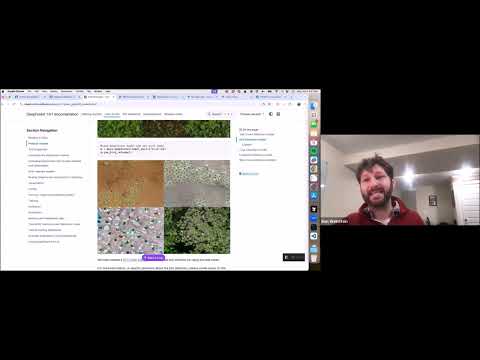

Hi all.
As AI practitioners for Conservation, what are for you the top 5 events/conferences you don’t want to miss in 2025?
I surely don’t want to mees UNOC 2025 (Ocean), NeurIPS, Marine Imaging Workshop and CVPR. How about you? 🙂
Joint event between GEOBON, OBIS, GBIF - Living Data conference (Oct. 21-24 in Bogotá)
https://www.livingdata2025.com/index.html
likewise living data for sure. also, i am kind of curious about compass (july 22-25, toronto)

I am biased, but I am looking forward to 2025 Nordic Workshop on AI for Climate Change. A new initiative from our research group.
"The workshop will feature presentations about Earth observation, computer vision, soundscape analysis, natural language processing, geometric machine learning, optimization, natural language processing, and multimodal modeling for climate related applications. Applications in green infrastructure, species distribution modeling, biodiversity monitoring."

Following, cause I need this.
Computational sustainability net was holding a conference thing, maybe apart of neurips now? https://www.compsust.net/events.php
Imageomics workshop at AAAi this year
Hello everyone,
We are pleased to announce that we will host the 3rd workshop on Machine Learning for Remote Sensing at ICLR 2025. It will take place in person in Singapore on April 27 or 28, 2025.
The Machine Learning for Remote Sensing workshop will provide a platform for machine learning research relevant for remote sensing and/or environmentally important applications. A panel of domain scientists from regional and international organizations will discuss key challenges in modeling remote sensing data at multiple scales, and our keynote speakers are leading researchers in the intersection of machine learning and remote sensing.
We invite submissions for 4-page non-archival research papers and Tiny Papers, with a submission deadline of February 03, 2025. See the website for more details.
We hope to see you there and look forward to your submissions,
- Hannah Kerner, on behalf of all organizers Marc Rußwurm, Ribana Roscher, Ronny Hänsch, Hamed Alemohammad, Gedeon Muhawenayo, Gabriel Tseng, Mirali Purohit, Evan Shelhamer, and Esther Rolf
Exciting (& free, of course!) webinar on automated monitoring of insects, hosted within the State of Insects RCN annual meeting.
Features talks from four experts on vision, radar, LiDAR and acoustic systems.
It's going to be really interesting 😉 sign-up below!
https://wildlabs.net/event/automated-insect-monitoring-across-modalities

This is super cool! I can't attend live, but would be interested in watching a recording if one will be available.
I’m (along with @Jose Ruiz-Munoz, @Santiago Ruiz Guzman and others!) excited to announce our upcoming workshop on ‘AI for ecological monitoring in the Andes’. Funded by WILDLABS, we are hosting a four-day session in Medellin, Colombia, from April 21st to 24th. Our aim is to bring together ecologists working with machine learning data for biodiversity science, as well as computer scientists interested in contributing to biodiversity conservation. Primarily aimed at students in Colombia and Ecuador, we hope to build skills in applied machine learning, share best development practices, and strengthen the network of scientists working at the intersection of machine learning and the environment. Each day will focus on developing models from different acquisition hardware, such as camera traps, drones, and autonomous audio recorders. Thanks to generous support from WILDLABS, travel assistance is available and lodging will be covered. The workshop will be taught in a mixture of English and Spanish. To apply visit https://weecology.github.io/AI_for_ecology_workshop/. Once accepted, applicants are expected to participate in pre-workshop activities. In addition, we would love to curate short virtual talks to highlight the growth in AI talent in Latin America. Get in touch with me at ben.weinstein@weecology.org.
Me complace anunciar nuestro próximo taller sobre "Inteligencia Artificial para el Monitoreo Ecológico en los Andes". El taller, financiado por WILDLABS, se llevará a cabo en Medellín, Colombia, del 21 al 24 de abril. Nuestro objetivo es reunir a ecólogos que trabajan con datos de aprendizaje automático para estudiar la biodiversidad, así como a científicos de datos interesados en contribuir a la conservación en los Andes. Dirigido principalmente a estudiantes e investigadores de Colombia y Ecuador, esperamos desarrollar habilidades avanzadas en aprendizaje automático aplicado, compartir las mejores prácticas metodológicas y fortalecer la red de científicos que trabajan en la intersección del aprendizaje automático y la conservación. Cada día se centrará en el desarrollo de modelos a partir de diferentes dispositivos de adquisición de datos, como cámaras trampa, drones y grabadoras de audio autónomas, con énfasis en aplicaciones prácticas para nuestros ecosistemas locales. El taller se impartirá en una combinación de inglés y español. Para aplicar, visita https://weecology.github.io/AI_for_ecology_workshop/.
Además, nos encantaría organizar charlas virtuales breves para destacar el creciente talento en IA en América Latina. Si estás interesado en presentar tu trabajo, escribe al correo ben.weinstein@weecology.org.https://wildlabs.net/event/taller-inteligencia-artificial-para-el-monitoreo-ecologico-en-los-andes-workshop-ai
So so cool @Ben Weinstein 🤩🤩🤩

I’m a postdoc at ESIIL and wanted to pass along information about the upcoming ESIIL Summit.
📣The Environmental Data Science and Inclusion Lab (ESIIL) is accepting applicants for the 2025 ESIIL Innovation Summit: Environmental Tipping Points and Transformation, an immersive, hands-on event where innovation meets collaboration. Apply today to join a community of passionate individuals working together to utilize the combination of open data and analytics opportunities to develop innovative or impactful approaches for understanding environmental tipping points and transformation. The Summit will take place at the University of Colorado Boulder from May 28-30, 2025. Visit the 2025 ESIIL Innovation Summit website for all the details and complete this application by January 31, 2025.

Hi I'm just seeing this, but I would love to attend. I'm also based in Denver/Golden. Can late apps be accepted?
I believe they aren’t accepting late applications, but you can email esiil@colorado.edu and they will follow up with you!
FYI - the ML for Remote Sensing workshop at ICLR 2025 deadline was extended one week to Feb 10!
https://aiforconservation.slack.com/archives/CM1JPL18R/p1736897470310609


ICLR asked that all workshops be in person and not hybrid this year, but we hope to have some remote participation option still - we will keep the website posted with this information. However submission presentations will have to be in person 😕

Hi all, just wanted to share a conservation/AI adjacent opportunity to do biophysics research in the Peruvian Amazon! While biophysics is the major theme, projects can be open-ended!
Applications are open for the annual "Jungle Biomechanics Lab," a fully funded two-week program, from August 3-17 at Finca Las Piedras in the Peruvian Amazon Rainforest.
This program, run annually, is a 2-week field research experience for early career scientists (from undergraduates to postdocs) funded by an NSF IRES grant. Participants will learn to collect data, run experiments in the field and complete their own project while living in the jungle. Travel with a team of researchers and do field biomechanics research, collaborate with a diverse cohort of U.S. and Peruvian scientists and students, and participate in science outreach events with local schools!
This is a fully funded program, we will cover your flights, housing, and food for the full trip!
To apply, you will need a one-page statement of interest, a CV, and a letter of reference. Applications are open now and will close on March 15th. Learn more on our website and apply here.


Summer school on “Artificial intelligence and citizen science in monitoring and assessing biodiversity and invasive species at sea” at AZTI
https://www.azti.es/en/event/summer-school-2025-artificial-intelligence-and-citizen-science-in-monitoring-and-assessing-biodiversity-and-invasive-species-at-sea/


A policy conference hosted by folks from my old job that could be of interest to some in this community:
https://www.worldbank.org/en/events/2025/04/29/measuring-development-2025


Hello everyone,
We are pleased to announce that we will host the
5th CV4Animals: Computer Vision for Animal Behavior Tracking and Modeling
at CVPR 2025. It will take place in person in Nashville, TN, USA on June 11 or 12, 2025.
The CV4Animals workshop aims to bring together experts from computer vision, neuroscience, biology, animal husbandry, ecology, and animal conservation to advance computer-vision-based animal behavior understanding.
We welcome submissions in 2 tracks:
- unpublished work up to 4 pages
- papers published within last 2 years
with a submission deadline of March 28, 2025.
For more details, stay updated via our website: CV4Animals
We look forward to an engaging workshop and hope to see many of you there!
Best,
The CV4Animals Organizing Team

LIMITS 2025 -- 11th Workshop on Computing within Limits -- June 26th-27th 2025 (Online/Hybrid) https://computingwithinlimits.org/2025/
For those in the DC area!
WILDLABS conservation tech meetup
- March 20, 6-9pm
- Mission Navy Yard (1221 Van St. SE)
Fun!! I'll be in DC that day and will stop by :)
It’s going to be like a happy hour so don’t think so unfortunately :(
omg me too! carly are you in dc?!
just moved here for a new job - will be great to catch up with you!!
@Carly Batist I'll be in DC 20th-22nd May, free on the 20th (and jetlagged) let me know if you are free for a meet-up. Also anyone else on this thread!
yesssss! i’ll follow up over whatsapp
Join the "Application of Machine Learning for Automated Quantification of Behavior" short course, taking place October 12-17, 2025, at The Jackson Laboratory in Bar Harbor, Maine – with an option to attend virtually! 🌍💻
🔍 Learn cutting-edge ML techniques for behavioral analysis
📍 In-person & virtual participation available
📅 Dates: October 12-17, 2025
🔗 More details: https://front.jax.org/education-and-learning/education-calendar/2025/10-october/sho[…]on-the-application-of-machine-learning-for-automated-quantific
A previous year’s course outline is attached for reference.
The 5th CV4Animals Workshop submission deadline is just two weeks away! 🕛⏳
🗓️ Deadline: March 28, 2025, at 11:59 PM (Pacific Time)
📌 Tracks:
🔹 Track 1 – Unpublished work
🔹 Track 2 – Published work
For full details, visit https://www.cv4animals.com/
Looking forward to seeing you all at CVPR! 🚀🎉
Registration is open for FedGeoDay 2025, taking place April 22-23 in Washington, DC at the Department of Interior and the American Red Cross buildings. FedGeoDay is uniquely dedicated to promoting open geospatial ecosystems—open-source software, open data, open science—being harnessed to build and support federal programs. Join geo-professionals, students and hobbyists from across disciplines (including environmental issues, climate change and conservation) and sectors for a variety of talks, panels, workshops and networking activities in the heart of the nation's capital!
PROGRAM
The theme of this year’s conference is Open Resilience: Using Open Geospatial Ecosystems to Predict, Prepare, and Respond. Sessions will emphasize how geospatial technologies—from remote-sensing satellites, to GeoML/GeoAI, to geospatial cloud-data platforms, to web mapping—can help bolster resilience to cyberattacks, floods, wildfires, earthquakes and other dangers.
- Day 1 (April 22) will feature talks and panels with speakers from technology companies, government agencies, nonprofits and more. Attendees will also have multiple chances to network with like-minded people, industry leaders and hirers in the public, private and nonprofit sectors.
- Day 2 (April 23) will feature technical workshops empowering you to acquire new skills in data engineering, AI and other topics, and learn about emerging technologies and trends from geospatial experts.
HOW TO ATTEND & GET INVOLVED
There's something for everyone at FedGeoDay 2025, regardless of your geo-experience level.
- Register: Early-bird savings are available until April 16!
- Volunteer at FedGeoDay: We are looking for volunteers to help with conference logistics. Just a few hours of your time can make a big difference—no geospatial experience required!
- Become a sponsor: We offer two sponsorship options.
QUESTIONS?
- Want to view content from past FedGeoDays? Click here.
- For all other questions, please email FedGeoDay 2025's chairs: Eddie Pickle, Monica Mardel and Bill Dollins.
Hope to see some of you at FedGeoDay 2025!

🚨 Only 1 week left! 🚨
The submission deadline for the CV4Animals Workshop is fast approaching! ⏳
Get your work ready and register for Track 1 now!
🔗 Register here: https://openreview.net/group?id=thecvf.com%2FCVPR%2F2025%2FWorkshop%2FCV4Animals#tab-your-consoles
🔗 More info: http://cv4animals.com
Also, in case you didn't notice, we're offering a number of FREE
conference and workshop registrations to the outstanding submissions 🙂
It was so nice meeting some of you at the WILDLABS.net happy hour in DC recently!
On April 16-30, NASA ARSET will be doing a free training-webinar series that will undoubtedly interest many folks here: Introduction to the Integration of Animal Tracking and Remote Sensing. Recommended prereqs include basic knowledge of remote sensing, spatial ecology, statistics, animal behavior and R programming.
I'm not on the ARSET team... just spreading the word! Register here.


Hi everyone,
I'm a PhD student, and I’ve been accepted for an oral presentation at ICCB2025 (International Congress for Conservation Biology). In my lab, most of the expertise is in AI, so my colleagues don’t necessarily have the background to assess which conferences are the best in ecology. I personally find it quite difficult to get reliable information on this as well.
I applied to ICCB because it is the conference of the Society for Conservation Biology. However, the event is taking place in Australia, while I live in Europe. Unfortunately, there is no option to present online, meaning I would have to fly there—something that I see as a major downside.
I’d love to hear your thoughts on this conference. If you’re familiar with it, do you think it’s a good one? What’s your opinion and perspective on it? Do you think it’s worth traveling that far for it? (I understand that everyone has different views on flying, and I’m not looking to start a debate on that—just seeking advice on the conference itself).
Thanks a lot for sharing your experiences! 😊

I really, really enjoyed my time at ICCB in 2023 and would definitely recommend the conference. It is a fabulous group of conservation practitioners from around the world and is a great place to network, hear about really impactful work, and talk with orgs/companies in the exhibition hall! If you can get your univ to help with travel costs to get there, I would say it's for sure worth it. I unfortunately won't be able to go this time and am very bummed to be missing!

I will attend ICCB this year, though it’ll be my first time there as well! I’m a phd candidate of geography based in the US (much more on the conservation end than the AI end). My former colleagues from conservation NGOs are also attending, and I think some people who do really amazing conservation science research I follow will also be there. Maybe it’s worth checking out the agenda for iccb2023 to see if topics match with your interest? Anyways I’m excited about it (not the flying though) : )
Thank you very much for taking the time to share your personal insight, it’s really helpful! :)) I am not sure what I will do but I will talk with my supervisors about your different opinion !

Definitely worth attending, especially as you've been accepted to present! You'll love it, I'm sure. I also wish that all conferences provided virtual presentation / attendance options (and especially those related to conservation!!).

📢 Call for Posters: CMCC ICC Workshop on AI for Carbon
I'm excited to share that the CMCC Foundation - Centro Euro Mediterraneo sui Cambiamenti Climatici has opened poster submissions for their upcoming workshop on Artificial Intelligence for Carbon (AI4C) taking place June 30-July 2, 2025 at the stunning Villa Grumello on Lake Como, Italy.
This workshop brings together leading researchers exploring how AI can advance carbon science across six critical domains:
- Earth System Modeling and Climate Dynamics
- Climate Predictions and Extremes
- Carbon Cycle and Earth System Monitoring
- Remote Sensing and Geospatial Applications
- Ecosystems and Biodiversity
- Economics, Policy, and Society
The event features an outstanding lineup of speakers from top industry and academic institutions.
📆 Poster submission details:
- Deadline: May 9th, 2025
- Notification of acceptance: May 20th, 2025
- Two interactive poster sessions with excellent networking opportunities
If you're working at the intersection of AI and carbon science, this is an excellent opportunity to share your research with the community and engage with leading experts in the field.
➡️ Full details and submission form: https://www.cmcc.it/lectures_conferences/icc-program-workshop-on-artificial-intelligence-for-carbon

Deadline extended to the 16th of May! We are looking forward to your submissions 🤩

Hey everyone,
we’re inviting submissions to a special issue of the IET Image Processing journal on "Computer Vision for Earth Observation and Environmental Monitoring"
This special issue aims at cutting-edge research at the intersection of machine vision and remote sensing, with a focus on Earth observation and environmental monitoring applications - including climate change impacts, marine pollution detection, land-use analysis, agriculture monitoring, and more.
Topics include, but are not limited to:
- Vision Language models for Earth observation
- Open-set, open-world, and open long-tailed recognition
- Multi-resolution, multi-temporal, multi-sensor, multi-modal techniques
- Hardware/software co-design for environmental applications
- Scalable, efficient machine vision systems
Submission Deadline: 1st December 2025
https://ietresearch.onlinelibrary.wiley.com/hub/journal/17519667/homepage/call-for-papers/si-2025-000252
Happy to chat if you’re interested!
Society for Conservation GIS (SCGIS), a group I'm in, is doing a free, virtual conservation GIS meetup on Thursday, May 8, at 10:00 AM PDT / 1:00 PM EDT / 7:00 PM CEST. All are welcome, including non-SCGIS members!
The meetup will feature breakout rooms offering you the chance to network with likeminded conservationists and GIS professionals and to learn about the SCGIS 2025 Conference, taking place June 30–July 2 in Shepherdstown, WV, USA.

Hi, came across a workshop for AI for Conservation from the 22-26th September 2025 in Oxford, UK.
https://www.linkedin.com/posts/amy-hinsley-69061028_what-should-the-future-of-ai-for-[…]m=member_desktop&rcm=ACoAACa85QsBM9L2ky58vUSZwmGmXD9wKcCLsrw
https://app.onlinesurveys.jisc.ac.uk/s/oxford/shaping-the-future-of-ai-for-conservation-application-form



📣 CamTrapAI Workshop 2025 in Seattle, USA hosted by Ai2 as hybrid event with online participation option on September 9-10!
📄 We just released the Call for Papers for extended abstracts (4 pages) and full papers (6 pages), specifically encouraging you to submit early findings and preliminary results.
🎯 Paper submission Deadline: July 1st (AOE)
🏅 Authors of selected best papers will be invited to submit extended versions to a Special Issue of the IET Computer Vision Journal.
✨ More information on the workshop website: https://camtrapai.github.io/workshop-2025.html

https://aiforconservation.slack.com/archives/CLWGQ4BJ6/p1748964119522489

The International Symposium on Computer Music Multidisciplinary Research (CMMR) will take place at University College London from November 3 to 7, 2025.
We are organizing a special session named “Listening With: Minds, Machines, Milieux, Machines and Musics”.
Important dates:
** June 29th: extended abstract (up to 2 pages including references) deadline
** August 15th: notification of acceptance
** September 12th: full paper (4–12 pages including references) deadline
** September 21st: author registration deadline
** November 3rd–7th: CMMR conference
The extended abstract and the full paper must be formatted according to the Springer LNCS single-column template. You may choose to write a short paper (4–8 pages) or a long paper (8–12 pages). Please visit: https://cmmr2025.prism.cnrs.fr/regular-paper-submission-guidelines.
This session aims to explore how humans perceive, interpret, and interact with their environments through sound. We welcome interdisciplinary contributions addressing ecological and embodied approaches to listening and audition across natural, musical, and artificial contexts. The session is open to theoretical, empirical, artistic, and technological perspectives.
Relevant topics include, but are not limited to:
- Ecological and embodied theories of auditory perception
- Environmental sound recording, soundscape studies, and auditory ethnography
- Sonic interaction design and auditory display
- Artistic or critical practices engaging with acoustic ecologies
- AI and machine learning approaches to auditory analysis and modeling
- Methodological innovations in auditory ecology research
All accepted papers will be published in the Springer Lecture Notes in Computer Science (LNCS) proceedings.
Further details about the session and the symposium are available at:
https://cmmr2025.prism.cnrs.fr/regular-paper-special-sessions/#human-auditory-ecology
Submission portal: https://cmt3.research.microsoft.com/CMMR2025
We look forward to reading your papers and to seeing you at CMMR later this year,
Etienne Thoret (CNRS / Aix-Marseille Université)
Vincent Lostanlen (CNRS / Nantes Université)
Hey all,
we’re inviting submissions to a special issue of the Frontiers in Remote Sensing journal on "Advanced Artificial Intelligence for Remote Sensing: Methods and Applications in Earth and Environmental Monitoring"
This special issue seeks to address critical gaps in remote sensing by fostering interdisciplinary dialogue on the integration of state-of-the-art AI technologies with remote sensing analysis, emphasizing both methodological rigor and practical relevance.
Topics of interest submissions are welcomed across the following themes (but not limited to):
- Multi-Modality Data Fusion
- Cross-Domain Adaptation & Generalization
- Benchmark Datasets
- Foundation Models for Remote Sensing
- Vision-Language Integration
- Downstream Applications
- Advanced Analytical Techniques
Summary Submission Deadline (2000 words): 27 July 2025
Paper Submission Deadline: 14 November 2025
https://www.frontiersin.org/research-topics/70908/advanced-artificial-intelligence-for-remote-sensing-methods-and-applications-in-earth-and-environmental-monitoring
Happy to chat if you’re interested!
I'm happy to announce two excellent keynote speakers for BioDCASE 2025! AND registration is open too! (It's free) All the details are here: https://biodcase.github.io/workshop2025/
📣 Call for Papers – MVEO 2025 @ BMVC! 📣
🌍 3rd Workshop on Machine Vision for Earth Observation and Environment Monitoring
📍 Sheffield, UK | 🗓️ 27 Nov 2025
🔗 https://mveo.github.io
We're back for another exciting edition! Join us to share and discuss cutting-edge computer vision for remote sensing and environmental monitoring 🌱📡
Topics include (but are not limited to):
🔹 Methods: Data-centric ML, generative models, vision language models (VLMs), open-world, self-supervised
🔹 Tasks: Classification, detection, segmentation, super-resolution
🔹 Applications: disaster response, climate change, marine monitoring, air/water quality, smart agriculture, and more
Important Dates:
📝 Submission: 22 Aug 2025
📢 Notifications: 19 Sep 2025
✅ Camera-ready: 26 Sep 2025

2025 Workshop on Camera Traps, AI, and Ecology - Registration Now Open
We are pleased to announce that registration is now open for the 2025 Workshop on Camera Traps, AI, and Ecology, to be held September 9–10 as a hybrid event in Seattle, USA, hosted by AI2.
The workshop will feature keynote talks from:
- Prof. Tanya Berger-Wolf – Director of the Translational Data Analytics Institute and Professor at The Ohio State University
- Prof. Iain Couzin – Director of the Max Planck Institute of Animal Behavior and Professor at the University of Konstanz
- Dr. Dan Morris – Senior Staff Research Scientist, Google AI for Nature
- Prof. Ulrik Pagh Schultz Lundquist – Head of the Drone Center, University of Southern Denmark
Please note that in-person attendance is limited to 30 participants, and early registration is strongly recommended. Online attendance will not be limited.
🔗 For more information and to register, visit: camtrapai.github.io
📅 The full program will be announced shortly.
[ MESSAGE TEXT EMPTY ]

The EnviBayes Workshop on Complex Environmental Data will be held at Texas A&M University October 29-31, 2025. Registration is now open!
Those interested in presenting a poster should email Dr. Raj Guhaniyogi (rajguhaniyogi@tamu.edu) by October 15, 2025. Some funding may be available for graduate students to attend the conference; stay tuned for more details.

[ MESSAGE TEXT EMPTY ]

Hi, we have two relevant workshops coming up at EurIPS in Copenhagen.
Both workshops have a call for papers (with different tracks for published work and novel worrk as 4-page extended abstracts).
Submission deadline: October 15, AoE
Workshop dates: December 6 & 7
- AICC: Workshop on AI for Climate and Conservation: https://sites.google.com/g.harvard.edu/aicceurips
- REO: Advances in Representation Learning for Earth Observation: https://sites.google.com/view/reoeurips
Thanks for sharing in your networks and looking forward to meeting many of you in Copenhagen.


Looking to meet up with some fellow AI for conservation peeps from around the world?
Join us tomorrow (Friday @ 9 am Pacific) for our WILDLABs AI For Conservation — Informal Networking event!
(Registration is quick & free.)
It'll be a great opportunity to meet other people, share what you're working on (or would like to be working on), without any pressure or presentations. @Josh Seltzer & @Viktor Domazetoski will be joining me to kick off the discussion, and we hope to see you there!

I am happy to announce the third annual SWISS CAM TRAP MEETING 2026. We will discuss the latest technological advances and foster collaboration and exchange among camera trapping users based in Switzerland. It will be held in person on January 22nd, 2026 in Fribourg, Switzerland.
If you are interested, you can sign up under the following link: https://forms.gle/LUs6ppxuYuxXhWs66
We hope to see you there!

Call for papers: Special Session on Neural Networks for Biodiversity at IEEE WCCI 2026 (June, Maastricht, The Netherlands) Deadline 31st January: https://www.ml4biodiversity.org/
[ MESSAGE TEXT EMPTY ]
Hello everyone, with a bunch of colleagues (including Florian Hartig, Pierre Bonnet, @Chiara Vanalli, @Sara Si-Moussi, Jakob Nyström), we are organising a thematic session at the next World Biodiversity Forum, in Davos, Switzerland (14-19 June 2026).
It is about Spatial models for biodiversity: exploring state of the art applications! We’d like to see works presented around the usage of heterogeneous data (remote sensing, bioacoustics, eDNA, etc) in AI models to serve biodiversity assessments and beyond!
More info here: https://meetingorganizer.copernicus.org/WBF2026/session/55420
Deadline for the abstracts is Tuesday, November 18 at 13h Swiss time. Don’t hesitate, it will be an awesome session! (And Davos is amazing in summer for hiking)
Registrations are open for the CNRS workshop on
"Emerging tropics in audio: ecoacoustics, environmental, urban, industrial, and medical acoustics"
which will be held at Ircam (Paris) next Thursday, November 13th, 2025.
We will hear four invited talks by Aurore Vicet (medical acoustics), Camille Desjonquères (ecoacoustics), Catherine Lavandier (urban acoustics), and Nicolas Misdariis (industrial acoustics and sound design).
Plus ten posters from early-career researchers on various areas of signal processing and machine learning for audio.
The event is hybrid, both in-person and remote (Zoom). It will be fully in English.
Registration link: (free but necessary to access the Ircam building or to obtain the Zoom password)
https://gdr-iasis.cnrs.fr/reunions/domaines-emergents-en-traitement-du-signal-audionumerique-eco-acoustique-environnements-urbains-industriels-et-medicaux-2/
click on "Inscription individuelle hors GdR", then enter name and affiliation.

cross-posting here for this upcoming networking event on November 19th!

Hi all!
MIT / Boston friends — I’m excited to be giving a talk today on Ai2's latest work building open and accessible AI including the just announced OlmoEarth platform 🌍 Talk be recorded and posted online if you can't make it (I will post a link to the comments here.
📍 LIDS Computing & Sustainability Seminar (Massachusetts Institute of Technology )
• Speaker: Patrick Beukema, Allen Institute for AI (Ai2)
• 🗓️ Date: Nov 17, 2025
• 🕓 Time: 4:00 - 5:00pm ET
• 📌 Location: Building 32-155
I’ll be talking about:
• What “Earth AI” should do for society
• A new open-source platform (https://lnkd.in/giw6e3eG) from Ai2 built in collaboration with a global group of partners tackling food security, wildfires, deforestation, ecosystem health, and more
• A new highly efficient and state-of-the-art foundation model we just released: https://lnkd.in/gYsD__DN
• How to get cost-effective, continual, real-time, global coverage from these models
• How academia, nonprofits, and frontier labs can collaborate more effectively
If you’re curious about how to align planetary-scale AI with real-world needs, I’d love to see you there. The talk will be recorded and posted online if you can’t make it.
👉 More details: https://lnkd.in/gM4iAB-h
https://www.linkedin.com/posts/plbeukema_mit-boston-friends-im-excited-to-be-activity[…]m=member_desktop&rcm=ACoAABQBJ4sBYPQGBY4uTeNZkHCKyfr_XwtOf0s
WILDLABS & partners are hosting the 1st International Conservation Technology Conference!
- Location: Lima, Peru
- Dates: February 16-20, 2026
- Program: Three core days of knowledge exchange, collaboration, and action (Feb 18-20), with workshop days Feb. 16-17
- Submit sessions here (due tomorrow!) and apply to be an exhibitor here (due Dec. 1)
https://whova.com/web/vKXxRYCYAKvvk25vdKeKfIrNzFk2kDi2XzbJbKyZxks%3D/
Bridging the Skills Gap: Computer Vision Training for Marine Ecologists
🗓️ 10th - 11th March 2026
🏠 British Antarctic Survey (Cambridge, UK)
Computer vision tools are transforming marine ecology, enabling researchers to work faster, more consistently, and at greater scales. However, many ecologists do not understand the underlying technologies, lowering their trust and confidence in deploying these tools for their own work.
Our 2-day in-person training workshop will bridge this skills gap, introducing the fundamental concepts, methods, and workflows required to apply computer vision to marine imagery. Participants will learn how to process raw data, build reproducible analyses, and interpret outputs with confidence, equipping them to integrate these approaches into their own research.
The workshop is free to attend (with limited travel/accommodation support) and open to UK-based researchers, with priority for PhD students and ECRs in benthic ecology. Minimal programming and no machine learning experience required.
Application deadline: 5pm (UK time), 30th January 2026.
More information and application link: https://sams-tom.github.io/marine-workshop-site/

[ MESSAGE TEXT EMPTY ]

📣 Join the Environmental Data Science Innovation and Impact Lab (ESIIL) for their 4th annual ESIIL Innovation Summit: AI for Sustainability in Boulder, Colorado from May 12-14! 🏔️ Attendees will dive into cutting-edge AI approaches for environmental data science, learn how to apply these methods within their own research and organizations, and collaborate on AI-ready datasets, tools, and use cases. There is no registration fee for accepted participants to attend the Summit, and a limited number of travel awards are available to help defray airfare/mileage and accommodation costs. Learn more and apply January 31, 2026.

The abstract deadline for the Acoustical Society of America spring meeting is coming up on Monday! Consider submitting to the special session on Machine Learning Approaches for Analyzing Large Acoustic Datasets, co-sponsored by the Animal Bioacoustics and Computational Acoustics committees. A particular emphasis will be on emerging and established techniques for analyzing bioacoustic datasets at scale in both marine and terrestrial domains 🪶
Where: Philadelphia, PA
When: May 11th-15th, 2026
Abstracts due: January 12th
Hello everyone,
We are pleased to announce that we will host the 4th workshop on Machine Learning for Remote Sensing at ICLR 2026. It will take place in person in Rio de Janeiro, Brazil on April 26 or 27, 2026.
This workshop promotes cross-disciplinary research through diverse viewpoints to tackle the pressing questions of our times, such as climate change, social inequalities, biodiversity, and food security. Developing modern machine learning approaches tailored towards remote sensing data is key to investigating these problems efficiently. The special theme of our workshop this year is “ML4RS: publication to practice”. Our workshop this year will focus on bridging gaps between research and real-world applications while continuing to catalyze state-of-the-art research through discussion and feedback on early-stage research.
This year we have several options for submission (all are non-archival) with a deadline of February 6, 2026 (AoE):
- Short research papers (4 pages) describing new and ongoing/in progress research.
- Tiny papers (2 pages) that present focused contributions at the intersection of machine learning and remote sensing.
- This year’s workshop features a new Tutorials track, which aims to expedite the use of new models, code libraries, datasets, and benchmark challenges – facilitating their use in both practical applications and comprehensive benchmarking in future research studies. We invite short papers (up to 4 pages) detailing a tutorial for a model, code library, dataset, or other contribution. We expect most (but not necessarily all) tutorials will be accompanied by an executable Colab notebook, Jupyter notebook, or other code files that can be run on a laptop.
We hope to see you there and look forward to your submissions,
- Hannah Kerner, on behalf of all organizers Esther Rolf, Bianca Zadrozny, Gabriel Tseng, Marc Rußwurm, Ronny Hänsch, Hamed Alemohammad, and Evan Shelhamer
https://aiforconservation.slack.com/archives/CLWGQ4BJ6/p1769450176628149


Hey everyone, for those attending the ICTC in Lima! join for a bioacoustics happy hour! (Moved to Thursday 19th!!!)
@Santiago Ruiz Guzman just flagging that there will be an ICTC welcome cocktail/opening reception on Wednesday night (~6-8pm-ish) so perhaps consider moving this to later or a different evening!

@Santiago Ruiz Guzman in the Whova app there is also a 'Meet-ups' group (go to 'Community' tab) to post this too if you want! 🙂

Looking to meet new collaborators at the intersection of AI and conservation?
Join us for the AI for Conservation Matchmaking event, bringing together computer scientists and conservation practitioners from around the world! Scheduled just before ICTC, this event is also the perfect opportunity to start building connections ahead of the conference.
Whether you’re analyzing camera trap data, developing machine learning models, or seeking partners to tackle real-world conservation challenges with AI, this is your chance to connect with like-minded people. All backgrounds and experience levels are welcome.
We’re hosting this special Valentine’s-themed “matchmaking” event because the best research collaborations are truly a match made in heaven. Complete a short survey in advance, and we’ll pair you with potential collaborators or like-minded people who share your interests and offer complementary expertise.
When: Thursday, February 12 at 9AM Pacific Time (5 PM GMT)
Register Here: https://luma.com/2rx368k1


“Meet at the dark monument” why do I feel like I’m about to participate in some kind of ritual :male_mage:

Just clarifying since there seem to be similarly named parks elsewhere in Lima, we're going to meet at the Clemente Revilla Park close to the conference center. Find it on Google Maps here or using the QR code

Hi All,
Last chance to register for our event tomorrow!
---------
Are you looking to meet new collaborators at the intersection of AI and conservation?
Join us for the AI for Conservation Matchmaking event, bringing together computer scientists and conservation practitioners from around the world! Scheduled just before ICTC, this event is also the perfect opportunity to start building connections ahead of the conference.
Whether you’re analyzing camera trap data, developing machine learning models, or seeking partners to tackle real-world conservation challenges with AI, this is your chance to connect with like-minded people. All backgrounds and experience levels are welcome.
We’re hosting this special Valentine’s-themed “matchmaking” event because the best research collaborations are truly a match made in heaven. Complete a short survey in advance, and we’ll pair you with potential collaborators or like-minded people who share your interests and offer complementary expertise.
When: Thursday, February 12 at 9AM Pacific Time (5 PM GMT)
Register Here: https://luma.com/2rx368k1

Hey Anna I just tried to fill out the form in the email but I got a
"Sorry, the file you have requested does not exist.
Make sure that you have the correct URL and the file exists."
I'm interested in camera trapping and edna and my background is AI Engineer integrating species classification models onto camera trap software. I'm also extremely interested in getting involved in field work.
Thank you guys for putting this together and it was nice to chat with you previously during Dan Morris's workshop series 🙂
Sorry about that! It looks like the notification cut off part of the link. Try this: https://docs.google.com/forms/d/e/1FAIpQLScn5YzS1ZtLOr8_rrayZNpjMjPqLlQ_KMsuHPSJvwERsI-Qyg/viewform?usp=header
Zoom fully died on me! Logging back in haha

Stand Up for Science is hosting rallies across the US on March 7th: https://www.standupforscience.net/march7


@Taneea S Agrawaal joined #upcoming_events. They’re also new to AI for Conservation.
@Rodrigo Oyanedel joined #upcoming_events. They’re also new to AI for Conservation.
@Daniel Haider joined #upcoming_events. They’re also new to AI for Conservation.

Hi all!
We are organizing a session "Machine Learning in Bioacoustics" at this year’s Forum Acusticum, taking place in Graz, Austria, from September 8-12, 2026: https://forum-acusticum.org/fa2026/.
The session brings together researchers in machine learning, acoustic engineering, and biology working at the interface of audio, animal behavior, communication, and ecology.
If you have something that you would like to share with the acoustics community and connect with fellow researchers, we warmly invite you to contribute :)
Contribution modes:
🐥 Peer-reviewed paper (4-6 pages) - submission until March 31, 2026
🐣 Talk only (abstract/title) - submission until April 30, 2026
If you have any questions, feel free to reach out!
Cheers,
Daniel Haider and Jure Železnik


@Yunxuan Chai (wsyxbcl) has joined the channel

@Marius Miron has joined the channel
Hello everyone,
TECNIACÚSTICA® 2026 (57th Spanish Congress on Acoustics – XIV Iberian Congress on Acoustics) will be held in Granada, Spain, from 21–23 October 2026. Contributions are invited for the Bioacoustics structured session (A02-1).
While papers in English are welcome, the congress is primarily oriented toward the Spanish and Portuguese acoustics research community, including researchers based in Spain or Portugal as well as those working abroad. Researchers from other countries who are professionally connected to the Iberian acoustics community—for example through research, collaboration, or work in Spain or Portugal—are also very welcome to participate.
Submitted contributions will be included in the congress program and proceedings as Invited Communications (CI).
Submission details
• Abstract (maximum 250 words) and full paper must be submitted online following the conference guidelines.
• Instructions and formatting guidelines for abstracts and full papers are available here:
https://www.tecniacustica.es/TECNIACUSTICA2026/comunicaciones/normativa
• Online submission portal:
https://www.tecniacustica.es/TECNIACUSTICA2026/comunicaciones/envio-online
Important deadlines
• Title and abstract submission: 15 May 2026
• Notification of acceptance: 15 June 2026
• Full paper submission: 7 September 2026
• Early-bird registration deadline: 30 July 2026
• Congress dates: 21–23 October 2026
As in previous editions of TECNIACÚSTICA, members of the organizing institutions (SEA, SPA, EAA, FIA, ICA, UCA) benefit from a reduced registration fee.
The conference also offers awards and travel grants for young researchers, including:
• Travel Grants for Young Acousticians
• Andrés Lara Award
Further information about the congress can be found on the conference website:
https://www.tecniacustica.es/TECNIACUSTICA2026
If you are interested in contributing to the Bioacoustics session, please feel free to get in touch.
Best regards,
Ester Vidaña Vila and Marius Miron
Bioacoustics Session Chairs
@Amanda Swayze-Rebeaud joined #upcoming_events. They’re also new to AI for Conservation.


@Tedi Yankov joined #upcoming_events. They’re also new to AI for Conservation.
@Salma Daadouch joined #upcoming_events. They’re also new to AI for Conservation.
@Edwin Arkel Rios joined #upcoming_events. They’re also new to AI for Conservation.

In connection with the AnimalCLEF2026 competition on re-identification on individual animals, we organise an online event. You will learn about the impact of re-identification and how it affects real-world projects. If you have not yet participated in the competition, you will make your first submission.
- When: Sunday, March 22, 14:00 CET.
- Where: The link is available at the event posted above.
- Price: Participants must register to attend the event. The registration is for free.
- The programme:
- Presentation of my experience with conducting re-identification projects on sea turtles. I will talk about projects in Greece, Egypt, Kenya or the Emirates.
- Discussion and questions.
- Introduction to AnimalCLEF2026 including going through the introductory notebook and making your first submission to the competition.

Voting is open for the Nature Tech Unconference 2026 agenda, and I'd love your support. The agenda is shaped entirely by community votes, so every vote genuinely counts.
I’ve submitted a session to discuss Ecosystem Condition: The Metric Everyone Cites and Nobody Agrees On. Ecosystem Condition is all over policy and finance, but how are people defining it? Who gets to decide? We want to encourage diverse perspectives and sincere discussion, and also get to concrete next steps for a working group or community position paper.
If you're already registered to attend Nature Tech Week in London this May, you can browse all proposed sessions and vote here by 29 March: https://bit.ly/NTUVoting
Not registered yet? You're very welcome to join us. Apply here first: https://www.naturetechcollective.org/nature-tech-unconference , then cast your vote.
Thanks and feel free to share this with anyone else who might be interested!


Anyone going to the Imageomics Conference at Ohio State University? I'm thinking about going
https://imageomics.osu.edu/conference-agenda

📢 ACCESS 2026 Summer School - Applications Open!
We're excited to announce the 2026 edition of ACCESS (Aarhus Computational Entomology Summer School) 🦟
🗓️ When: Sep 14-18, 2026 📍 Where: Kaløvigcenter, near Aarhus, Denmark 💰 Funding: Up to 15 fully-funded spots + some self-funded slots ⏰ Deadline: April 30th
Perfect for grad students/postdocs in biology or data science who want to work on automated insect monitoring, AI pipelines, and field hardware. You'll build a team project with international mentors and build skills at the cutting edge of biodiversity monitoring in scenic surroundings 🌲
Interested? For more details and how to apply visit the course website
🔗 https://darsa.info/ACCESS-2026/
Know someone who'd be interested? Please share! 📧
Workshop
AI4Nature@AVSS2026
https://www.ai4nature.tech
Computer Vision and AI for Environmental Monitoring, Biodiversity Analysis, and Ecosystem Restoration
The global climate and biodiversity crises demand a paradigm shift in how we monitor, analyze, and protect our natural world. This workshop, AI4Nature, explores the transformative role of advanced visual and signal-based systems in addressing these challenges. In alignment with AVSS 2026's theme of “Expanding Horizons,” we move beyond traditional security and surveillance to focus on ecological and environmental applications. The workshop will showcase cutting-edge research in computer vision, deep learning, and multi-modal sensor fusion for the automated monitoring of biodiversity (e.g., species identification, population counting, behavioral analysis), the detection of environmental threats (e.g., pollution, poaching, wildfire, invasive species), and the assessment of ecosystem health. By bringing together computer vision researchers, ecologists, and environmental scientists, AI4Nature aims to foster interdisciplinary collaboration and chart a roadmap for a new generation of intelligent, autonomous systems dedicated to the sustainability and restoration of our planet’s ecosystems.
Topics
The workshop will focus on, but is not limited to, the following topics:
1. Computer Vision for Biodiversity Analysis:
- AI-driven species identification, counting, and tracking from camera traps, baited remote underwater video systems (Bruvs), drones, and underwater vehicles.
- Individual animal re-identification using biometrics (e.g., fur patterns, scars, fin shapes) for population studies.
- Automated analysis of animal behavior and social interactions in the wild.
2. Multi-Modal Environmental Monitoring:
- Sensor fusion for ecological surveillance, combining video, audio (bioacoustics), thermal, LiDAR, and eDNA data.
- Anomaly detection (and early-warning systems) for environmental threats such as poaching, illegal logging, pollution events (e.g., oil spills, microplastics), invasive species, and wildfire ignition.
- Multimodal foundation models for understanding complex ecosystem dynamics, linking visual data with climatic and chemical parameters.
3. Autonomous Systems for Ecology:
-UAV/drone-based monitoring of remote or inaccessible habitats (forests, coastlines, marine protected areas).
- Autonomous surface and underwater vehicles for marine biodiversity assessment and seafloor habitat mapping.
- Edge AI for real-time, in-situ analysis on robotic platforms, enabling adaptive mission planning.
4. AI for Ecosystem Health and Restoration:
- Habitat change detection using high-resolution satellite and aerial imagery.
- Assessment of restoration interventions through automated vegetation and geomorphological analysis.
- Digital twins of ecosystems for predictive modeling and scenario analysis to support evidence-based conservation interventions and policy.
This workshop is highly timely as the European Union’s Green Deal, Biodiversity Strategy 2030, and Nature Restoration Law create an urgent demand for the scalable, accurate, and cost-effective monitoring technologies that our community can provide
Submission https://cmt3.research.microsoft.com/AIforNATURE2026
Important dates
Paper submission deadline May 20, 2026
Notification of acceptance June 10, 2026
Camera ready deadline July 1, 2026
Workshop date August 31, 2026
Is anyone going to any San Francisco Climate Week events?
https://sfcw.climate-week.org/
The call for abstracts for The International Statistical Ecology Conference (ISEC) closes this week, on May 1 (anywhere on Earth). Join us and submit an abstract here: https://docs.google.com/forms/d/e/1FAIpQLSdskGF1mnCwTGeqYAlkkbqGZeAR2Ac_I0kBbwPi1NXz2piRpg/viewform
Abstracts have a limit of 1500 characters and are limited to 1 per presenting author. Folks with accepted abstracts will be notified by early July in order to give individuals that require a visa to travel to México enough time to obtain one.
Registration costs & workshop costs have also been posted on the website. We will pass along more information regarding registration before it opens in June (tentatively) as well as information on how to apply for a scholarship and excursion details (occurring on January 10, 2027). We will be offering 14 workshops over the course of two days, January 8-9, 2027. The titles and instructors are displayed on the front page of the website (https://statisticalecology.org) while full details are given here. All workshops will offer assistance with translation between Spanish & English, either through a Spanish/English-speaking instructor or a designated helper assigned to the workshop.
Looking forward to seeing you all in Mérida!
- ISEC 2027 Scientific & Organizing Committees

This is a bit of a different workshop, but thought it may be relevant to some.
AI Capability Uplift That Actually Works workshop, part of the IEEE eScience conference (28th September - 2nd October 2026)
The workshop will focus on practical case studies of AI and data capability programs across academia, government, industry, and faith-based organisations (more information on this point will be revealed at the workshop). We’re especially interested in what people are trying, who they’re delivering these programs to (e.g., executives, recently graduated data scientists, early- and mid-career researchers, public-sector professionals, religious leaders), what’s working, what isn’t, and what others can learn from those experiences.
We’re now inviting people to submit papers (2 - 4 page extended abstracts). The deadline for submission is the 1st June 2026. If you would like to submit something but don't have time to write before 1st June, please get in touch so we can discuss it. My email address is georgia.atkinson@newcastle.ac.uk. Happy to answer any questions also🙂.

This conference session may be of interest for people working on biodiversity data and interested in resilience and risk mitigation. The call for papers is open until May 20th.
The session “Building Resilient Data Infrastructures for Biodiversity Science” will take place at the conference TDWG 2026 in Oslo, Norway, in September 2026. Paper proposals can be submitted using this link. The session (full abstract here) wants to discuss how data infrastructures in biodiversity science are addressing resilience and risk mitigation in the face of current challenges (cyberattacks, aggressive data scraping, loss of technical expertise, sudden funding cuts, political decisions limiting data access, etc.).
Grab your morning coffee (or evening beer) and join us for a casual hour of chatting about how AI is being used to protect wildlife, track ecosystems, and tackle environmental challenges. Whether you're building conservation tech, are curious about the field, or just want to nerd out about camera traps and satellite imagery, this is your chance to connect with others working at this intersection.
This month we're hosting two networking sessions to reach a wider range of time zones. Looking forward to seeing you there this Thursday/Friday (21st/22nd of May)!
- Session #1 - 9 am Pacific | 4 pm GMT | 2 am Australian Eastern Time - https://luma.com/tat9ywbd
- Session #2 - 4 pm Pacific | 11 pm GMT | 9 am Australian Eastern Time - https://luma.com/rsgvwxov


Deadline extended to June 5th AoE
AI4Nature: Computer Vision and AI for Environmental Monitoring, Biodiversity Analysis, and Ecosystem Restoration @ AVSS 2026
Co-sponsored by IEEE Computer Society and IEEE Signal Processing Society
How can AI help us monitor, understand, and protect nature?
As part of AVSS 2026, the AI4Nature workshop will explore how computer vision, deep learning, multimodal sensing, and autonomous systems can support biodiversity monitoring, ecosystem health assessment, and the detection of environmental threats such as wildfires, pollution, and poaching.
Aligned with the AVSS 2026 theme, Beyond Monitoring, AI4Nature opens new perspectives for applying visual and signal-based technologies to sustainability, conservation, and ecosystem restoration.
Main topics
• Computer Vision for Biodiversity Analysis
• Multi-Modal Environmental Monitoring
• Autonomous Systems for Ecology
• AI for Ecosystem Health and Restoration.
Paper submission deadline: June 5th, 2026
More details: www.ai4nature.tech

For anyone near UC San Diego next week, the lab I'm in - the Societal Computing and Innovation Lab is having a public-facing poster session where we demo the immersive visualization tools we are developing for visualizing physics-guided forest fire models and marine animal behavior!
Save the date! BioDCASE 2026 will be ONLINE on Friday 23rd October. Join for the latest in solving bioacoustics challenges. https://biodcase.github.io/workshop2026/

Fancy a trip to Colombia in September? We will have the 3rd Colombian Congress of Bioacoustics and Ecoacoustics in Bogotá. While the congress has been in Spanish, this year we will open submissions and presentations in Portuguese and English. Our community is growing fast, and it's a very friendly space to explore new collaborations! @Daniela Ruiz, @Maria Jose Guerrero, @Alejandro Jaramillo, and I are co-organising a symposium about bioacoustic AI for the Neotropics (attached are more details). The abstract deadline is on June 12th. See you in Bogotá!
Today on Zoom at 15 (free registration required):
https://www.ri.se/en/gustau-camps-valls-a-critical-look-at-explainable-ai

The program for the AI4Nature workshop is out
https://www.ai4nature.tech/program.html
Excited to announce the next Climate Change AI workshop will be held at NeurIPS 2026 in Sydney. The submission deadline is August 29 - with Calls for Papers (4 pages), Proposals (3 pages), or Tutorials (Jupyter notebook). More details here: climatechange.ai/events/neurips2026