Public Channels
- # ai4pacificislandseabirds
- # animal_re-id
- # audio
- # biodcase-active-learning-community
- # camera-traps-hardware
- # camera_traps
- # camtrapai-workshops
- # cv4animals
- # cv4plants
- # cvml-solutions-for-challenging-real-world-conservation-problems
- # datasets
- # elephant_id_database_general
- # esa_2023_happy_hour
- # general
- # geometric_embedding_analysis
- # help_needed
- # jobs
- # marine
- # movement
- # new_papers
- # news
- # ourpapers
- # petitions
- # proj-id-and-count-salmon
- # public-engagement
- # random
- # region-pnw
- # region-us-ne
- # region-us-sw
- # resources
- # tdwg_ml
- # upcoming_events
- # vibe-coding-party
- # visualization
- # what-is-that
- # wildlifeinsights

set the channel description: ML approaches for audio data


@Stefan Schneider has joined the channel
Set this up for future audio discussions, before I forget


Thanks Sara! I am copying here a message that I just wrote in another channel: Hello everybody, my name is Silvia Zuffi, my topic is 3D animal (quadruped) modeling, but I have a question for a new thing that I want to explore not related to quadrupeds. I want to record and analyze/detect the voice of fishes. We have done some initial recordings, and well, it is hard to say what we got. I was wondering if among the people here there is somebody that has experience in capturing underwater sound. Thank you!

Hey @Silvia Zuffi I haven't worked with fish, but have worked with audio recordings of bats. I can't point to someone specifically but there is good marine audio experience at Cornell and St Andrew's (https://synergy.st-andrews.ac.uk/marinebioacoustics/).

Hi @Silvia Zuffi, you can contact Aaron Rice (https://www.birds.cornell.edu/ccb/aaron-rice/). He is the fish guy in my lab and I am sure he would be happy to help (if you still have a need for it)!

Thank you Holger, it sounds a bit strange to reply after so long, but I put this project on hold and maybe I will resume it soon, so thank you for your reply!
http://www.soest.hawaii.edu/ore/dclde/
For thos interested in the automated detection/classification of marine mammal calls 🙂
https://www.aicrowd.com/challenges/lifeclef-2020-bird-monophone

There is an upcoming WildLabs meetup all about audio, you can find out more and register here: https://www.wildlabs.net/resources/events/wildlabs-virtual-meetup-invitation-acoustic-monitoring


Hi, I'm new to slack and just getting into using acoustic monitoring. I'm going to be using machine learning to classify recordings for bats. From my literature search it seems like some good options that are already available for this are bat detective and waveman, but I'm interested in what other folks are using and developing. (Sorry if I'm posting this in the wrong place; I'm still learning my way around here.)

https://github.com/YvesBas/Tadarida-C

Thank you @Oisin Mac Aodha! Have you tried Tadarida-C and compared it's performance to your bat detective software?
Hey @Mikey Tabak Not directly. In our paper we compared to a random forest baseline that uses simple features derived from the input spectrograms.
Big challenge in this space is the lack of large scale annotated datasets.
Yes-it seems like getting good annotated data is really hard. There aren't many experts in IDing species by sound.

@Suzanne Stathatos has joined the channel

@Omiros Pantazis has joined the channel

Congrats to Rainforest Connections and Sieve Analytics in recent merge!! Go Topher and Mitch!
-signed, your admiring fans at the Songs of Adaptation project 😊
Our Kaggle competition is live. If you have any questions about the competition, please let me know! https://www.kaggle.com/c/birdsong-recognition/overview


@felix Michaud has joined the channel

@Sylvain HAUPERT has joined the channel

@Anthony J Giordano has joined the channel


@Brian Hutchinson has joined the channel

BirdCLEF 2021 competition is live: https://www.kaggle.com/c/birdclef-2021/overview

https://www.eurekalert.org/pub_releases/2021-06/cu-gte060421.php


Hello all! 👋 Is there anyone here working on gibbon 🐵 vocalisations? If so drop me a message I'd love to hear about your work 😄
Yes. Our postdoc Dena Clink is: https://www.birds.cornell.edu/ccb/dena-j-clink-ph-d/
Slow-Fast Auditory Streams for Audio Recognition
Evangelos Kazakos, Arsha Nagrani, Andrew Zisserman and Dima Damen
"We propose a two-stream convolutional network for audio recognition, that operates on time-frequency spectrogram inputs. Following similar success in visual recognition, we learn Slow-Fast auditory streams with separable convolutions and multi-level lateral connections. The Slow pathway has high channel capacity while the Fast pathway operates at a fine-grained temporal resolution. We showcase the importance of our two-stream proposal on two diverse datasets: VGG-Sound and EPIC-KITCHENS-100, and achieve state-of-the-art results on both."
https://ekazakos.github.io/auditoryslowfast/
just won an outstanding paper award at ICASSP :)
Is anyone here studying the Hainan peacock-pheasant (Polyplectron katsumatae)? 🧐
Any good book recommendations for bioacoustics and/or audio processing?
Did you see @gvanhorn's recent blog posts? Not a book but I found them really helpful 🙂
https://www.macaulaylibrary.org/2021/07/19/from-sound-to-images-part-1-a-deep-dive-on-spectrogram-creation/
https://www.macaulaylibrary.org/2021/08/05/from-sound-to-images-part-2-spectrogram-image-processing/
oh wow these two posts are super awesome!! Will definitely share these with my next students
I haven't, but I'll look into them. I ask as my department has some funds they haven't used so I want some books, because, books!

Good morning everyone. There is a fellow grad student in one of the labs that I am associated with who has run into a bit of a bind due to supply chain issues. She was hoping to deploy AudioMoths this summer as part of a Masters project, but they are currently out of stock everywhere she's looked. With fingers crossed, I thought I would check if anyone knows of any ARUs collecting dust this summer that would be available for rent or loan?

You might try posting on WILDLABS as well! I’ve seen posts about this on there before
Hello all! Anyone here actively working in ML and bioacoustics and has time to chat and bounce ideas on an on/off basis?
Hi all, we have published recently a report on some work we have been doing on fish sounds, I would be interested in some feedback and suggestions! https://arxiv.org/abs/2201.05013v2

https://www.kaggle.com/c/birdclef-2022/overview


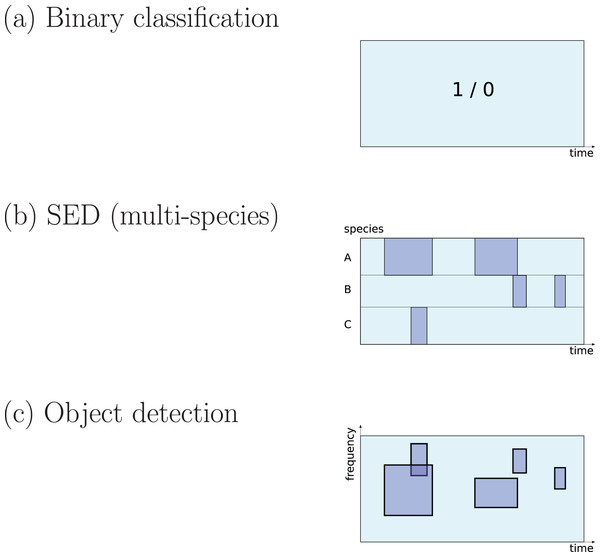
https://peerj.com/articles/13152/
We are finally able to share a GUI-enabled version of BirdNET. See: https://github.com/kahst/BirdNET-Analyzer In addition to 2000+ bird species, this version also includes a bunch of North American frog and mammal species. This is a beta, if you run into any issues, please let us know!

Hi all — excited to be here! I’m Masato, a Senior AI Researcher working at Earth Species Project. We’ve been working on an exciting project where we build a standardized benchmark for bioacoustics (“ESP Bioacoustics Benchmark”) and I’m wondering if anyone here is interested in providing early feedback for this project.
Here I copied the project description:
Machine learning (ML) and deep learning (DL) have been increasingly used for solving bioacoustics tasks, but typical research studies in bioacoustics focus on different types of species and ML/DL models, making it difficult to compare across different approaches in a standardized way. Inspired by the benchmark datasets in other ML domains such as ImageNet and GLUE, we propose the ESP Bioacoustic Benchmark, a collection of bioacoustics tasks and datasets specifically designed to measure and compare the performance of ML algorithms in a standardized way. We specifically focus on the two unique aspects of bioacoustics—diversity of species and the small data size, and design the benchmark so that it rewards ML models that address these two issues successfully. We also publish the preprocessed datasets, the library code, and non-DL and DL baseline implementations to make it easier to reproduce and build new models on top of the benchmark infrastructure.
Here are some key questions we would like to see answered:
- Would you be interested in using this benchmark? Why and why not?
- Does the current selection of datasets make sense? What would you add and/or remove?
- Would you be interested in contributing a dataset for this?
The full project description can be found here. https://earthspecies.notion.site/ESP-Bioacoustic-Benchmark-b6d5ef9327ae4f3983c1923bb7e33ab2
Feel free to reach out to me via direct messages or at masato@earthspecies.org. We are also happy to provide more information and hope on a call if it works better. (Copying my colleague and the co-founder of ESP @Katie Zacarian)

Good afternoon everyone. It seems like many paper I read laud bioacoustic monitoring as a reasonable large-scale monitoring approach; however, I'm not aware of that many programs which have deployed recorders and intend to maintain them indefinitely. I'd like to compile a list of applied long-term acoustic monitoring programs (i.e. programs that are managed like they will exist for years) and I was hoping I could tap into the wealth of knowledge here.
I'll start by listing the Forest Service bioacoustic monitoring program in the Pacific Northwest of the US.
You should check the Conservation Tech Directory! I know we've got tons of those large-scale projects listed on there. https://conservationtech.directory/


Anyone else going to AudioXD? https://kitzeslab.github.io/audioxd/
I wish!! Very sad I had a conflicting event then so I can’t. But looking forward to hearing about it later!

This channel is - ironically - very quiet. And it's Friday, so I'm going to post something that doesn't really offer anything of value, just a neat bioacoustics experience I had today... this morning I was walking my dog in a quiet park, and we heard a sound that first seemed like another (upset) dog, but then I noticed it was sort of doing a call-and-response with what was clearly an owl, so I thought maybe the unusual sound was a juvenile owl. It also made my dog completely lose her mind, so I didn't quite manage to get a clean recording of the unknown sound, but Merlin (a) did an amazing job ignoring my barking dog and (b) told me that the adult owl was a great horned owl, so when I got home, I searched for "great horned owl juvenile sounds", and voila, this is exactly what we heard:
https://www.youtube.com/watch?v=uQDnPDaOXyI
It's wild how good a job Merlin did ignoring my dog in this recording and identifying the owl, which must be around 1% as loud as the dog sounds:
https://drive.google.com/file/d/1MiwW5JiW-lFTTiyN7A9osMpHNbylWd9v/view?usp=sharing
Huge props to the Merlin Sound ID team, that's amazing!

Dear audio channel, I would like to ask a suggestion. We have done some work on sound separation for fish vocalizations, but I am not really in the field, and I was wondering what could be a venue (small conference/workshop) to present the work. Any suggestions? https://arxiv.org/abs/2201.05013v2

If you're after a fish related conference rather than comp sci conference then try the American Fisheries Society annual meeting, or FSBI in the UK
Thank you, I was thinking more at a workshop on AI/computational methods in bioacoustics…

I’ve seen some of the big conferences like ICML, ICASSP, Big Data have workshops on this sort of topic in the past but from what I’ve seen they aren’t consistently ran every year

Another option: https://acousticalsociety.org/asa-meetings/
Hello Everyone, Happy New Year !
I am Félix Michaud, PhD student at Sorbonne Université and the National Museum of Natural History in Paris under the supervision of Jérôme Sueur and Sylvain Haupert. We are very happy to share our work dedicated to the reduction of label noise in bird sound datasets detailed in the new paper Unsupervised classification to improve the quality of a bird song recording dataset.
You will find the code available here : https://github.com/ear-team/bambird
Hi everyone. I’ve just had an email off IBAC saying their conference is now open for abstract submissions and thought it might be of interest to people here 🙂 https://2023.ibac.info/index.html
https://academicjobsonline.org/ajo/jobs/24693
I've been flipping through a number of published avian bioacoustic datasets today and I am not seeing many with intraspecies call type labels. Is anyone aware of any published datasets with call and song type labels?
NIPS4b has call and songs
Picidea has some intraspecies labels

The BirdCLEF dataset has a type category (https://www.kaggle.com/competitions/birdclef-2023). However, just looking at it now it seems to contain a lot of categories. I guess these are entered by the community (the data I believe is from Xeno-Canto) and that there is not really a standard for how to enter it, but this is mainly a guess.
Quick analysis in python using pandas tells us that these 20 types make up ~85% of the data, and they are somewhat overlapping. Maybe helpful.
Hey! I have been using the BirdNET-Analyzer model v2.4 to compute embeddings for a research project I am working on. If any of the authors are here, thanks for making this model available! It works very well.
Does anyone know if there exists a detailed description of the model architecture used in BirdNET v2.4? From the version history the architecture changed to using EfficientNet V2 blocks in v1.2, and I assume that there has been a lot of changes as well until v2.4. I believe that the paper ("BirdNET: A deep learning solution for avian diversity monitoring") describes the initial Wide-ResNet model, correct me if I am wrong.
Any pointers to where I can find a description of the current architecture (if this is available) would be very welcome!
Hi John, I can find this information and will get back to you.
And thank you for the great work you are doing at Cornell with this model (and bioacoustics in general).
Thanks! Actually, could you do me a favor and ask this question as an "issue" on the Analyzer GitHub page? Then others will be able to look this up also. Thanks!

I am also interested in this. It would be great if you could post the link to the issue here. As for the code for the model, it's not available, right? I noticed an attempt to convert the weights into a PyTorch model, but it seems they gave up on it. https://github.com/dsgt-birdclef/birdclef-2023/issues/29
Sure! Here is the link to the issue: https://github.com/kahst/BirdNET-Analyzer/issues/177
 <a href="https://github.com/kahst/BirdNET-Analyzer">kahst/BirdNET-Analyzer</a>
Hello!
I am thinking about the best hardware to record some audio at a site in the Baltic Sea where we are studying Guillemots. It is a rather nice site in the sense that both networking and power infrastructure is already in place, and currently cameras are set up to take images of the birds, but no audio is being recorded. The cameras seem to encode audio at a G.711 standard meaning that it is sampled at 8kHz, which is not sufficient, otherwise simply connecting microphones to the cameras would have been a great alternative.
The easiest type of audio recording device to integrate into this site would be something that just needs a power supply and with a file system that can be accessed via wifi. I have not really found anything like this and may be looking in the wrong places. The AudioMoth may be an option if we install the USB Microphone firmware and connect it to a Raspberry Pi or something for networking capabilities, but I am wondering if there may be anything else out there that is doing these things out of the box?
Question: Does anyone know of an acoustic recording device which runs on power supplied by a cable (no need to replace batteries) and with a file system that is accessible over wifi?
Yes there is! I would go with a Barix Instreamer (https://www.barix.com/product/instreamers/) and stream the data from the site to your lab. There you can set up a server to store the data and analyze it (you can also listen in, which is nice).
Thanks for the tip Holger! I'll look into that.
Sure. Let me know if you have questions. Cheers!
Maybe one more question. Would you recommend any specific microphones for these?
That depends on your budget :) I like the GRAS 41 series. I have been using one of those continously for years (permanent outdoor installation in Ithaca, NY) and never had a problem.
Good answer 🙂 I'll look into that. Thanks again!

Hey Folks, bottom line up front: ❓ Has anyone heard of a tool for classification of the black grouse from audio recording?
Context below:
A friend of a friend of mine, leads a research project piloting the monitoring of black grouse in the Izera Mountains using acoustic recorders. Story as old as time -- manual listening and identifying birbs takes a tremendous amount of time for them. They tried a few tools, namely CornelLab - Merlin, but nothing they tried was identifying black grouse correctly.

I have used the latest version of BirdNET on black grouse and it seemed to work pretty well (although the grouse were very loud in my recordings)
The Google Perch team are working to make these kind of problems much easier to solve. See: https://colab.research.google.com/drive/1gPBu2fyw6aoT-zxXFk15I2GObfMRNHUq?usp=sharing
This notebook demo takes users through a human in the loop agile modelling framework which builds a classifier for any bird sound the user wants to find, then outputs a csv file with all these. You can work on your own data by replicating the file structure used for the example dataset and target sound.
It can be run entirely from one Colab notebook using data uploaded to Google Drive (though I would recommend using Google Cloud instead of Drive if using <100k raw audio files). Or, local install on linux works nicely. The GitHub is here: https://github.com/google-research/perch/tree/main
I've been using this for coral reef audio where its been a real game changer!


I’d also recommend checking out HawkEars, it doesn’t have Black Grouse as a class but it’s a pytorch model which can be fine-tuned or retrained on new classes easily. The github is great https://github.com/jhuus/HawkEars
and it can also be accessed via the bioacoustics-model-zoo if you want to use the opensoundscape api

Hi Andrzej,
I also use BirdNET for Black grouse and Capercaillie.
You can easily retrain models for your species:
Check out this paper on Rock Ptarmigan Lagopus muta:
https://onlinelibrary.wiley.com/doi/full/10.1111/ibi.13314
Greetings from Austria,
Robin

Hey Andrzej, if none of these tools are suitable, my team would be happy to look into making something custom. Feel free to DM 🙂
Thank you everyone for the information and recommendations! I'll pass them on to my friend, see what they make of it! 🙂 🙏
Hi all, this week we released our pretrained model 'SurfPerch' which is a highly effective transfer learner for new datasets from coral reefs and similar habitats (available on Kaggle). It can be easily fine tuned to find any reef or fish like sound you want with far less training data and compute cost. We have a tutorial demonstrating how this can can be performed using example data on gdrive with google colab alongside an active learning process for added labelling speed: https://github.com/BenUCL/surfperch/blob/surfperch/SurfPerch_Demo_with_Calling_in_Our_Corals.ipynb
Our research article detailing the models creation is on arvix: https://arxiv.org/abs/2404.16436. As part of this we assembled and open source ReefSet, an annotated library of 57k reef sounds across 38 classes from 16 unrelated datasets: https://paperswithcode.com/dataset/reefset
There's also a blog post on Google's keyword blog: https://blog.google/outreach-initiatives/arts-culture/a-new-ai-tool-to-help-monitor-coral-reef-health/


 <a href="https://github.com/BenUCL/surfperch">BenUCL/surfperch</a>

Hi! I've been using BirdNET this week, what are you trying to do? It gave me some problems and difficulties but at the end I could do what I wanted

its scripts - but it points to a non existant model (its 404)
Hmm, just to make sure, I checked the github repo (the updated one) and I can't see the fetch_model file: https://github.com/kahst/BirdNET-Analyzer. But in the outdated version of BirdNET I can see it (https://github.com/kahst/BirdNET). Which repo are you using?
Oops, no problem, it has happen to me too. If you need anything else I can also try to help you. Just for your information, I tried to use the python functions in my own python script but at the end it was easier to use the GUI. Good luck!
fab ! do you know a good place to find example audio ?
as u can tell im just testing out the tech at this point
hahah, it's good to test before using for a real project. Well, maybe if you already have an idea of what you would like to do at the end it would be easier to find example audio to use. (Just check the analyzer, train a model and then analyze with custom classifier, check with only one audio, check with multiple audio files, use focal call/songs, background audios...
you have called me out on my lack of focus ^_^
I directly used my research data, but kaggle has a lot of datasets, maybe you can find a good one: https://www.kaggle.com/search?q=bird+audio+in%3Adatasets
And read the repo documentation super carefully
yeah, there are a lot of well-known audio libraries but some of them have been using for the training, to start using birdnet it's cool, but it will probably give you better results than with out-of-domain data which is the real case in most researches
You can also check BirdNET paper in case that you haven't. It's from 2021, with the deprecated version, and changes has been done (the backbone model for example). But it gives you a lot of interesesing information about BirdNET

Hello, all! My name is Clare, and I am at UBC’s Institute for Resources, Environment, and Sustainability working on my Master’s. I previously worked with the late Dr. Karen Bakker on her book about interspecies communication and acoustics (hence my introduction into this space).
My thesis is looking into the relationship between anthropogenic noise and birdsong in urban soundscapes, probing at perceptions of nature and spaces (as being “good” or “bad” for recreation, spending time in nature, etc) as a function of the soundscape. I was wondering if any of you were aware of a program, or had trained one yourself, that can classify presence/absence (ideally relative abundance as well) of what I am thinking of as sound “guilds” (attributes like construction, road sound, birds, geophonic sound, human beings, etc) in a soundscape recording. The alternative is to design soundscapes with controlled attribute (“guild”) ratios; if anyone has experience doing that, I would also love to connect. I am reachable here, or at my email theclareprice@gmail.com. Thanks so much, looking forward to chatting 🙂

@Clare Price it's not quite what you are asking for, but we have done some work on mapping soundscapes: https://arxiv.org/pdf/2309.10667. Take a look and let me know if that seems potentially useful for your work.
If you don't need the mapping part, you could potentially use CLAP (https://ieeexplore.ieee.org/abstract/document/10095969) with some prompt engineering to determine the categories.
You might try checking out different acoustic indices - this user guide is a great place to start! https://ecohack.shinyapps.io/Acoustic_Index_Users_Guide/

Hi Clare! A couple datasets you could use if you wanted to train one yourself -
The freefield 1010 dataset - https://paperswithcode.com/dataset/freefield1010 has a good variety of classes
UrbanSound8k contains some classes that are similar to your guilds - https://urbansounddataset.weebly.com/urbansound8k.html and you might find some useful references here - https://urbansounddataset.weebly.com/taxonomy.html



I am happy to share that our latest work "From Weak to Strong Sound Event Labels using Adaptive Change-Point Detection and Active Learning" has been accepted at EUSIPCO 2024 and nominated to the best student paper category.
- code: https://github.com/johnmartinsson/adaptive-change-point-detection
- paper: https://eurasip.org/Proceedings/Eusipco/Eusipco2024/pdfs/0000902.pdf
- data: https://zenodo.org/records/10811797
We propose a method to collect strong sound event annotations in a cost efficient way, while still keeping the annotation task very simple by only asking the annotator to provide class labels for given audio segments. The method is demonstrated on bioacoustic sound data (🐦), but should in principle work for any sound data (and potentially many other types of time series data) with fairly minor changes.
Just reposting this here - https://aiforconservation.slack.com/archives/CLWGQ4BJ6/p1724704711146579

Hi everyone,
I'm preparing a manuscript, and we have also published a bioacoustic dataset (focused on bird sounds and soundscapes). The editor is satisfied with the structure and metadata we've created, but they are requiring us to specify the ISO standard used for the metadata description. We based our work on other datasets, and while the editor is OK with that, we’re unsure which ISO standard to reference, as we don’t know what standards those datasets were following.
Does anyone know which ISO standard(s) might apply to bioacoustic datasets, or how we could align our metadata description with ISO recommendations?
Thanks in advance for any guidance!
As far as I know, there isn't an ISO standard out there for this kind of data (only on how the date/time should be encoded, etc.). We are working on a metadata standard that will hopefully be published through the Acoustical Society of America soon. What I would suggest you do is to reach out to the Associated Editor. The editor can reach out to the reviewer and ask for additional information on the ISO standard in question. Best of luck!
Actually, we've already reached out to the editor regarding this, but unfortunately, they didn't provide a specific ISO standard either. They only mentioned that there are many ISO standards out there, and we should search online for one that applies. We've tried that but haven't been able to pinpoint anything relevant for bioacoustic data specifically. Thank you for your response!

Hello all! Does anyone have knowledge of or experience with any off-the-shelf, wireless, ARUs? I.e. like an AudioMoth that has cellular or satellite connectivity? I'm starting to explore what's out there and thus far I am aware of Rainforest Connection's Guardian system, these Automated Surveying Units by Instinct Environmental, and these more DIY units designed by Oekofor called ecoPi
Edge-detection and the ability to load custom BirdNet weights would also be hugely valuable
Hi Nathaniel, if you have questions about the ecoPIs, send me a direct message. This is a project we are running right now using them: https://birdnet.cornell.edu/swamp/
Super cool @Holger Klinck! Let me do some more homework but I may take you up on that.
Haikubox and Birdweather PUCs do real-time detections (sends alerts to an app on your phone)


@Carly Batist these look great especially for a backyard, but unfortunately neither seem to have built in cellular or satellite modems so might be tougher to deploy in remote settings. I might try reaching out to them directly to make sure though.

Hi all. This whole time I didn't know we had an "audio" channel here. So 👋 !
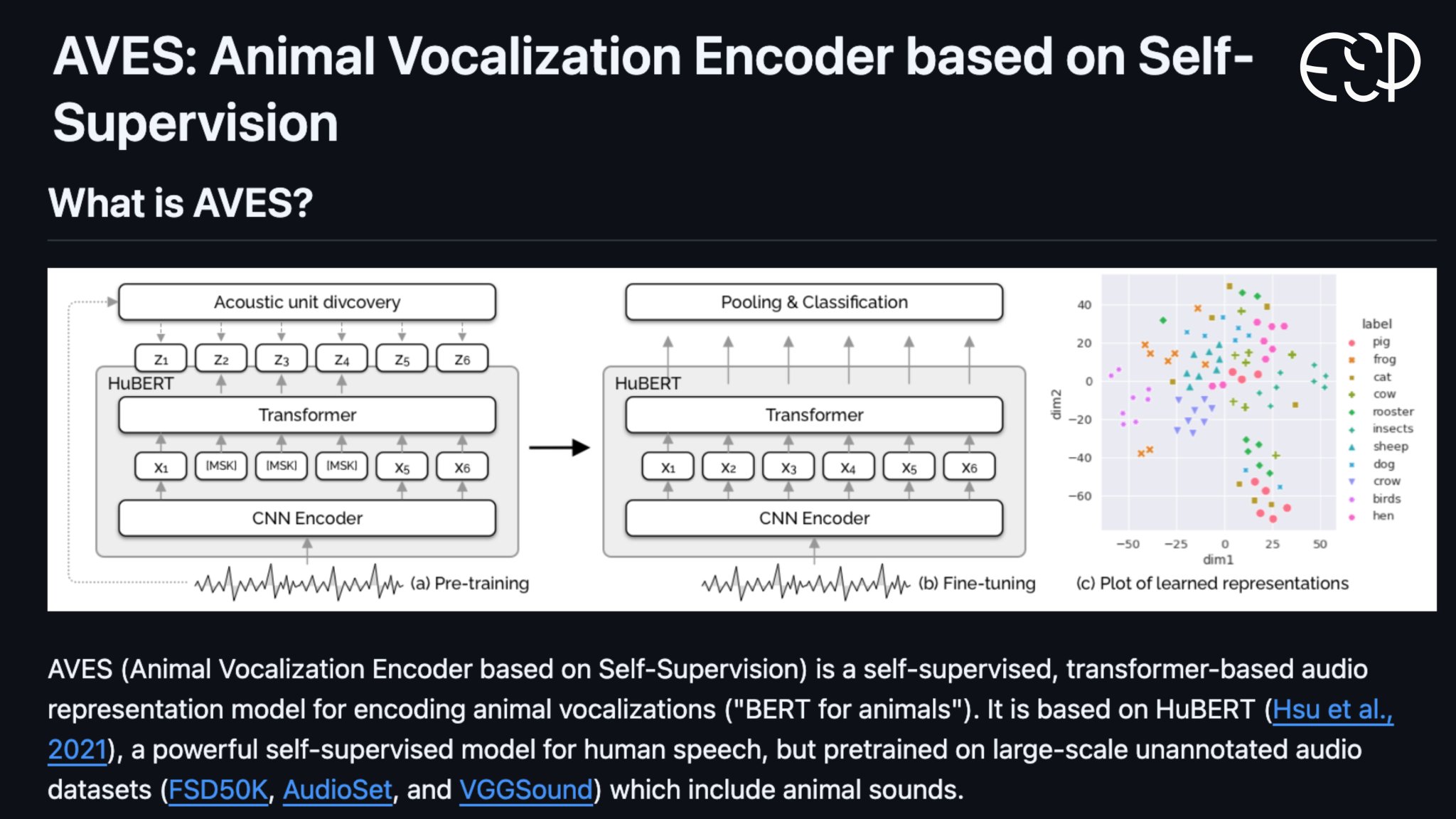
Hi all, our self-supervised audio encoder for animal sounds, AVES, is now pip-installable! This means that you can install the package and get the embeddings from audio files with a single command without writing any code. More details below ⬇️ https://x.com/earthspecies/status/1912205602257772649
👋 Hello from Earth Species Project!
We’re thrilled to share that we’ve open-sourced NatureLM-audio, the world’s first audio-language foundation model for bioacoustics. This release includes:
- the model weights
- inference code
- the newly curated BEANS-Zero benchmark
- and our evaluation toolkit
Our goal is to make these tools accessible to the global research community and support new breakthroughs in AI for conservation.
🔗 Explore the model and resources here: https://earthspecies.github.io/naturelm-audio-demo/
📍 We’ll also be presenting NatureLM-audio at ICLR 2025 in Singapore this week. If you’re attending, come say hi at Poster 584 this Saturday (4/26)!

Had a new paper out where we show embeddings from pretrained NN's can be used to train classifiers or unsupervised learning algs to explore marine soundscapes pretty much as well as NN's trained from scratch, and do much better than 'hand crafted features'. The findings seem pretty obvious now but when the work was first done in 2021 this was still a new topic! It was hard to find good data so it spent a lot of back and forth time in review hence the delay.
https://journals.plos.org/ploscompbiol/article?id=10.1371/journal.pcbi.1013029
I want to share a webpage about a recent bioacoustic monitoring setup that we have established at the Auk Lab at Stora Karlsö in the Baltic Sea. The Auk Lab has been monitoring and collecting data about Common Guillemots at Stora Karlsö for over a decade, and this year I was fortunate enough to be part of a bioacoustic monitoring installation on the island. These seabirds are important indicators of the overall health of the ecosystems in the Baltic Sea. Hopefully we will learn more about the Guillemots from their vocalizations.
There will be many interesting audio-visual and other multimodal modelling challenges here (the curent weather conditions are logged every second et cetera), which will make for fun audio modelling problems. Can we jointly identify audio-visual behavior cues to learn more about what a certain vocalization might mean? Can wind and rain noise reduction methods be informed by the logged weather data? It is going to be fun trying to figure it out!

I'm proud to say that the results of the first BioDCASE Challenge are now online! Click "Results" here: https://biodcase.github.io/challenge2025/
We have a new preprint out using AI accelerated passive acoustic monitoring of coral reefs to measure ecological outcomes from restoration that I hope is of interest to some: https://doi.org/10.1101/2025.09.24.678197 🪸
- We gathered data from 45 sites across five countries totaling >12 months of raw audio. We used SurfPerch and the Google Perch teams incredible 'agile modelling' workflow to build 34 classifiers for common fish and invertebrate sounds, generating 912k high confidence detections of these.
- We used these detections as indicators of four important coral reef ecosystem functions (fish recruitment, fish diversity, parrotfish grazing, shrimp bioturbation). This revealed recovery in 3/4 functions on restored reefs around 3yrs of age, with some bouncing back within just 3mo at some locations.
- We've also published the full raw audio dataset and all 912k detections open-source on figshare for anyone to use (about 800GB once unzipped): https://doi.org/10.5522/04/29958062.v2 - would love to hear if anyone finds uses for this!
This was a huge collaborative effort between several NGO's, the incredible buildcoral.com restoration team, and academics, who all feature as co-authors.



Hi all, we’re Synature (https://synature.ch/en/), building tools to make bioacoustics more accessible. We offer a smart microphone that auto-uploads recordings to reduce fieldwork overhead, and an intuitive data management platform.
We’re looking for users (individuals or organizations) to pilot our data management platform (we have species detection and bioacoustic indices on the platform). The only requirement: you already have audio data ready to upload.
Please complete this short form if you're interested: https://forms.gle/Vh8btMSvthXoMfKf7


Hello! I just joined this Slack channel, happy to be here. I'm a machine learning specialist working at Ocean Networks Canada (ONC), primarily focusing on passive acoustic monitoring and classification of "anomalies" (e.g., instrumentation failures, environmental sounds, marine mammal sounds) in ocean recordings. I am wondering if anyone knows of any citizen science based projects for crowd-sourced annotations in this domain. Especially any that might allow ONC to upload its data.

Hi Spencer, that sounds exciting! Unfortunately, there aren't any platforms for citzen-science driven annotations for ocean bioacoustics at scale, but it's something that I think a lot about. I'd love to learn more about the data that you're working with and specifically what you're looking to detect!
Thanks for the information! It's something I've been thinking about too. I'd be very interested in potentially leading or collaborating on an effort for a project of this sort.
The work I've done at ONC is primarily focused on finding instrumentation anomalies on our network of hydrophones (mostly on the west coast of Canada), so that we can both provide quality assurance information to users of our data and know when to service the instruments. The work I've done so far is in this Github repo: https://github.com/Spiffical/selfsupervision_anomalies_onc
Some results I've gotten are summarized in this presentation I recently gave: https://docs.google.com/presentation/d/1mq5d9RKRBwTvHsyukVen_3gzwjrg_3ZS0QQK9TTO2ZA/edit?usp=sharing
I am happy to discuss this more!
I just accepted a new position at ONC where I'll be moving beyond instrumentation anomalies and focusing more on bioacoustics (primarily whales); detection, segmentation, triangulation, population counts, etc. This work will begin in January, so I'm just starting to think of the process now. 🙂
This is super exciting, and congrats on your new position! I'm thinking about a very similar space of challenges with bioacoustic data at large, and I'd love to chat more. I'll send you a dm to try and coordinate a quick call 🙂
Hello just chiming in here, if you don’t find a tool or platform for what you need I’d be happy to talk about helping build one. I’m an AI + full stack dev very interested in and looking to expand in this area! Have some ideas for such a platform as have previously explored something similar in relation to bat calls…
I am doing some prototyping around supply chain mapping, and I want to have a few publicly-available schematics/BOMs for electronic devices handy whose supply chains I can analyze (I can do this for proprietary Google things, but that doesn't help me talk about the work to anyone outside Google). It doesn't matter if the actual products have anything to do with conservation or sustainability, but I figure, why not choose a sustainability-related product for demos... to that end, AudioMoth came to mind, and I can find a zillion places on the Internet telling me that for all versions older than the current version, the schematic+BOM should be available, but I can't actually find the schematic/BOM. Does anyone have a link? If it matters, I don't actually care about the schematic, only the parts list / BOM, but I can determine the latter from the former if the schematic is the only thing that is easily available.

Have you tried posted in the AM support forum? Alex and team are pretty responsive there!

A complete bill of materials for AudioMoth 1 is in the AudioMoth paper: https://www.sciencedirect.com/science/article/pii/S2468067219300306
And you've probably already seen, but just in case, that the data sheets on GitHub have some hardware details for the key components, e.g. processor and microphone: https://github.com/OpenAcousticDevices/Datasheets
@Joe Nash The BOM in the paper is exactly what I was looking for... I did go to the paper site, but skipped right to the supplementary materials, which includes downloads that looked right, but they were actually descriptions of the housings and some ancillary assemblies. The BOM in the paper is exactly what I needed, thanks!

We can dig up the schematics as well if it turns out to be relevant

I built a bioacoustics webapp for personal use that runs model inference in the browser similar to similar to the BirdNET webapp but with more acoustic analysis features. I'd appreciate any feedback from the community. Disclaimer: not a bioacoustics expert, just trying to build cool tools and learn in the process
https://isaac.earth/bioacoustics
Cool! I'm also working on a bioacoustics gui and look forward to checking this out!

@Santiago Martinez Balvanera You probably going to like this!! 🙂

Wow, pretty neat!
Also, I'm v interested in a GUI for (batch) inference. Mainly for bat models, but I think it would be great, if possible, to have a somewhat generic GUI that can run any model as long as it is adapted to it's requirements. @Sam Lapp is that similar to what you're doing?
@Isaac Corley, in my experience bioacousticians would really love to have the ability to get the predictions in a tabular format to feed into further analysis.
Yes @Santiago Martinez Balvanera I'll share the app soon. I'm curious what format the models you would like to run are in. Feel free to dm or email to discuss, or check out the in progress app on my GitHub (Dipper)
Thanks for the feedback all! I'm currently exporting to json but I agree, tabular might be ideal.
This webapp was focused around running model inference in the browser using onnxruntime-web if the model is exported to onnx which uses webGPU if available and doesn't need the model code only the onnx checkpoint. I’m not sure if this would be the best way to run batched inference though — I'm guessing you mean on a large directory of audio files?
I was made aware recently of bioacoustics model zoo so I'll be adding more models to detect other types of species
Our colleague Stuart Newson asked me to post this survey! 📝
How are automated species identifications from passive acoustic monitoring verified and quality-assured in practice?
Automated acoustic species identification is now widely used for birds, bats, amphibians, and other terrestrial taxa — but approaches to verification, uncertainty, and quality assurance vary widely between tools, projects, and sectors.
British Trust for Ornithology (BTO), working with Natural England and funded by Department for Environment, Food and Rural Affairs, is running a short anonymous survey to understand current practice around automated species identification in Passive Acoustic Monitoring, and to identify challenges and guidance needs.
We’d love to hear from:
▪️ Developers and researchers building or validating automated acoustic species classifiers.
▪️ Ecological consultants, regulators, NGOs, and monitoring leads using automated species identification outputs.
⏱️ ~20 minutes | 🔒 Anonymous | 📝 Informing future best practice and guidance
Take part here ➡️ https://docs.google.com/forms/d/e/1FAIpQLSdaHB8fJuSptUoMHDbfOSTU4pOBVCp7D0zLOfCzz76SYEZDtw/viewform
Please share with relevant colleagues or networks — broad input across taxa and application areas is essential.

@Rodrigo Oyanedel joined #audio. They’re also new to AI for Conservation.


Hi!
My research has a localization component and I am running into an issue with signal alignment. The internal clocks in the ARUs I used (Song Meter Micro) drift, so recordings that were programmed to be synchronized are out of phase. Does anyone have experience with/recommendations for synchronization of audio recordings?
Thanks!

yup, i’ll send a dm
@Lucas Mateo Waldburger joined #audio. They’re also new to AI for Conservation.

@Edwin Arkel Rios has joined the channel

At Bat Conservation Trust, we are gathering evidence to support research into storage strategies for passive acoustic monitoring (PAM) project data. Would you be able to spare 10 minutes of your time to fill in our anonymous survey and contribute to our research?
Survey on storage of passive acoustic monitoring data – Fill out form
The work is part of the National Woodland Bat Survey, a collaboration between Bat Conservation Trust and Forest Research, funded by the UK government through Defra’s Natural Capital and Ecosystem Assessment programme (NCEA) with support from Bat Conservation Trust. We aim to use the results from the survey in a peer reviewed journal article.
Any questions at all please let us know. We thank you very much for taking the time to give your valuable input into this work.
We would be very grateful if you could share within your networks. If you do not work with passive acoustic monitoring data, please forward on to a colleague or contact who might be able to contribute.

Hi, I recently annotated a couple of MP3 files downloaded from Xeno Canto, with bounding boxes in Raven Lite (v.2.0.5). When loading that MP3 and its annotations into Python (via soundfile, torchaudio, or librosa), the annotations didn’t align properly with the audio. It seems to be due to the encoder delay on MP3 files, which Raven Lite is treating differently vs. other softwares.
Checking in with my colleagues, no one knew about this particular behavior but there was general agreement that it’s best to work in WAV across softwares. It got me wondering: is this behavior in Raven widely known? Are there similar situations others have encountered, regarding interoperability/file types/etc? Any best practices that you follow when creating datasets? Thanks!
Definitely interesting, I haven't tried using XC annotations yet but imagine it's supposed to work across software without any hassle, including with mp3. Raven stores the annotations as text so should be able to see if they are correct relative to audio file start time? Perhaps you could share the audio and annotation examples
Sorry if I wasn’t clear, I made the annotations myself in Raven

Hi 👋 Raven developer here. We were not aware of this issue but were able to reproduce it just now. The sound library underlying Raven Lite and Pro is old and not maintained, so it's not surprising it has some issues. We are no longer releasing updates to Raven Lite or Pro as development is focused on Raven Workbench, our modernized suite of apps (all 100% free). We recommend trying out Raven Annotate, which does not have this issue!
Wasn’t aware of the new suite! That’s great. Thanks for checking if it happens in the new tools
@Maddie Cusimano feel free to message me if you have questions/feedback on the new apps!
Excited to try them out, thanks for reaching out

@Maddie Cusimano this might be overkill but you can somewhat easily (batch) convert audio from mp3 to wav using a library like ffmpeg
true, and you can also use Raven Compass for batch conversion if you like a GUI option!
[ MESSAGE TEXT EMPTY ]

Dipper Desktop PAM software
Hi friends! I’ve been working with @Matt Weldy and the Kitzes Lab on a desktop GUI for efficiently running bioacoustics foundation models on PAM datasets, selecting detections for review, and rapidly annotating detected clips. It’s called Dipper and is in active development, so I would love to hear feedback if you have feature requests, suggestions, or bug reports (as github issues). The app supports running all major foundation models (BirdNET, Perch 2, HawkEars, etc), runs on Windows/Mac/Linux, uses GPU to accelerate inference when available, and can be deployed in Server mode for remote web-app access. I see it as complimentary to the existing (and awesome) BirdNET GUI and Chirpity tools, with Dipper’s focus being on large-scale data workflows and efficient keyboard-based annotation when you need to review thousands of clips (e.g.: I need verified detection histories from heaps of PAM data). Looking forward to hearing from you if you try it out!
sammlapp.github.io/dipper
We had a paper using a tiny CNN to detect bomb fishing come out this week. Copying my click baity linked in post below for anyone interested!
Bomb dropped on global coral reef hotspot once every 62 minutes 👇 🪸 💣
Last year the public were shocked to see how destructive bottom trawling is after watching David Attenborough's Ocean documentary. Yet did you know people literally throw bombs onto coral reefs to catch fish?
🌏 - Bomb fishing has been reported in 34 countries, and is a devastatingly effective way to cause ecological collapse. Repeat bomb fishing turns thriving reefs into moonlike rubble fields that are unable to recover, pictured below.
🎙️ - We deployed a single Open Acoustic Devices audio recorder on a rolling basis in an Indo-pacific coral reef and trained a tiny AI model to listen for bombs. Across 3650 hrs of audio we detected and verified 3570 blasts. Thats almost 8500 annually, enough to destroy three football pitches of reef every year - heard by just this one recorder!
⚠️ - We show the technology barrier to monitoring this practice is no longer the bottleneck. Baselines can easily be gethered from any impacted area and used to measure the progress of interventions. Targeted interventions are now the challenge, every new location requires carefully balanced community work from the ground up, alternative livlihood campaigns and enforcement.
Our free to read open access paper: zslpublications.onlinelibrary.wiley.com/doi/10.1002/…


I've not been as active on slack lately, if anyone's interested to reach out on this you can get me on ben@echolabs.org